Dark-eyed Junco
Return to visitors index
Scientific Name:
Junco hyemalis
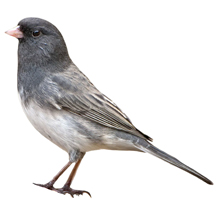
Brief Description: The Dark-eyed Junco is a small, abundant North American sparrow easily recognized by its crisp, unstreaked markings, contrastingly bright white outer tail feathers that flash in flight, and a distinct pale pink bill. Highly social birds that spend most of their time hopping and running across the ground rather than perching high up. They form large, structured winter flocks. Widely nicknamed the "Snowbird" because their sudden arrival in suburban yards often predicts the return of cold winter weather.
Plumage: The plumage of the Dark-eyed Junco is incredibly diverse across North America, though all variations share three core features: bright white outer tail feathers that flash in flight, a pale pink bill, and a crisply defined white belly. For decades, these regional variations were classified as distinct species, but they are now recognized as six distinct geographic plumage groups. Regardless of the regional group, young juncos look notably different from adults during their first summer. They exhibit heavily streaked brown and gray camouflage plumage across their breast and back, strongly resembling standard sparrows until they undergo their first fall molt.
Habitat: Dark-eyed Juncos are highly adaptable birds that transition between two distinct habitats. During the summer, they breed in mature coniferous and mixed forests, particularly in mountainous and boreal regions. In winter, they migrate or shift down in elevation to spend time in open woodlands, brushy fields, suburbs, parks, and backyard feeding areas. During the summer breeding habitat usually they are found in dense coniferous and mixed-coniferous forests (such as pine, fir, and spruce), as well as deciduous forests (such as aspen and oak).
Egg & Nest Details: Dark-eyed Juncos build open, cup-shaped nests on the ground, often tucked under rocks, roots, or building foundations. The female lays 3 to 5 pale, speckled eggs and incubates them for 12 to 13 days. The chicks leave the nest just 10 to 13 days after hatching. The nest is a woven outer layer of twigs and moss, lined with soft grasses, animal fur, or feathers. It is mostly hidden on the ground in a small depression on a sloping hill. Sometimes on building ledges, flower pots, or light fixtures.
Diet: Dark-eyed Juncos are primarily ground-feeding foragers. Their diet consists of about 75% seeds and 25% insects, though the insect portion increases during the summer breeding season. In the wild, they eat weed seeds, grains, and various invertebrates. At bird feeders, they are strictly ground-feeders. They will occasionally eat berries and waste grains in agricultural fields.
Sounds: Dark-eyed Juncos possess an array of distinct vocalizations, ranging from musical trills to sharp, mechanical clicks. Because these birds have 15 different regional subspecies, their vocalizations feature subtle regional "accents" depending on where you encounter them.
Brief Description: The Dark-eyed Junco is a small, abundant North American sparrow easily recognized by its crisp, unstreaked markings, contrastingly bright white outer tail feathers that flash in flight, and a distinct pale pink bill. Highly social birds that spend most of their time hopping and running across the ground rather than perching high up. They form large, structured winter flocks. Widely nicknamed the "Snowbird" because their sudden arrival in suburban yards often predicts the return of cold winter weather.
Plumage: The plumage of the Dark-eyed Junco is incredibly diverse across North America, though all variations share three core features: bright white outer tail feathers that flash in flight, a pale pink bill, and a crisply defined white belly. For decades, these regional variations were classified as distinct species, but they are now recognized as six distinct geographic plumage groups. Regardless of the regional group, young juncos look notably different from adults during their first summer. They exhibit heavily streaked brown and gray camouflage plumage across their breast and back, strongly resembling standard sparrows until they undergo their first fall molt.
Habitat: Dark-eyed Juncos are highly adaptable birds that transition between two distinct habitats. During the summer, they breed in mature coniferous and mixed forests, particularly in mountainous and boreal regions. In winter, they migrate or shift down in elevation to spend time in open woodlands, brushy fields, suburbs, parks, and backyard feeding areas. During the summer breeding habitat usually they are found in dense coniferous and mixed-coniferous forests (such as pine, fir, and spruce), as well as deciduous forests (such as aspen and oak).
Egg & Nest Details: Dark-eyed Juncos build open, cup-shaped nests on the ground, often tucked under rocks, roots, or building foundations. The female lays 3 to 5 pale, speckled eggs and incubates them for 12 to 13 days. The chicks leave the nest just 10 to 13 days after hatching. The nest is a woven outer layer of twigs and moss, lined with soft grasses, animal fur, or feathers. It is mostly hidden on the ground in a small depression on a sloping hill. Sometimes on building ledges, flower pots, or light fixtures.
Diet: Dark-eyed Juncos are primarily ground-feeding foragers. Their diet consists of about 75% seeds and 25% insects, though the insect portion increases during the summer breeding season. In the wild, they eat weed seeds, grains, and various invertebrates. At bird feeders, they are strictly ground-feeders. They will occasionally eat berries and waste grains in agricultural fields.
Sounds: Dark-eyed Juncos possess an array of distinct vocalizations, ranging from musical trills to sharp, mechanical clicks. Because these birds have 15 different regional subspecies, their vocalizations feature subtle regional "accents" depending on where you encounter them.