Coopers Hawk
Return to visitors index
Scientific Name:
Astur cooperii
Brief Description: The Cooper’s Hawk is a medium-sized bird of prey known for its incredible agility and high-speed, weaving flight through dense forest canopies. They feature broad, rounded wings and a very long, striped tail, making them masterful at ambushing other birds and small mammals. Females are noticeably larger than males, typically measuring 15–20 inches in length with a wingspan of 27–36 inches. They possess short, rounded wings and a very long, banded tail with a rounded tip. This anatomical design acts like a rudder, allowing them to make sharp, high-speed twists through heavy tree branches.
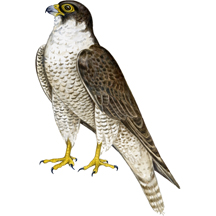
Plumage: Cooper’s Hawk plumage changes dramatically with age. Adults feature steely blue-gray backs, dark caps, and reddish-barred underparts. In contrast, juveniles are brown above with vertically streaked, cream-colored chests. Both stages have long, rounded tails with alternating dark bands and a wide white tip. Long, rounded, and prominently tipped tail with white, featuring three to four thick blackish bands. Yellow-green eyes in young adults, darkening to a deep orange or dark red in older birds.
Habitat: Cooper's Hawks inhabit deciduous, mixed, and coniferous forests across North America. Highly adapted for dense environments, these birds use their short, rounded wings and long tails to maneuver through trees. They have also successfully adapted to urban and suburban neighborhoods, where mature trees and bird feeders provide abundant prey. Historically found in dense, mature forests, they prefer areas with a clear understory that allows them to ambush prey from a hidden perch. They frequently roam forest edges and patchy woodlands.
Egg & Nest Details: Cooper's Hawks build large, bulky stick nests in the main crotch or on horizontal branches of deciduous and coniferous trees, typically 25 to 50 feet off the ground. They lay 3 to 5 pale, bluish-white eggs over several days and incubate them for roughly 30 to 36 days. They typically construct their nests 25 to 65 feet above ground, hidden in dense woods, but they are increasingly common in urban and residential neighborhoods.Material: Nests are built primarily out of sticks and lined with strips of bark (such as oak, pine, or birch).
Diet: Cooper's hawks eat primarily small to medium-sized birds, such as mourning doves, pigeons, starlings, robins, and jays. Because they are ambush predators that heavily utilize urban environments, they are frequent visitors to backyard bird feeders, where they hunt the songbirds gathered there. Also Chipmunks, mice, tree squirrels, bats, small lizards, frogs, and large insects.
Sounds: The Cooper's Hawk is usually silent outside of the breeding season, but they become highly vocal when defending their nests or interacting with a mate. Unlike the long, piercing, downward scream of a Red-tailed Hawk, a Cooper's Hawk relies on short, rapid, repetitive cackling sounds.
Brief Description: The Cooper’s Hawk is a medium-sized bird of prey known for its incredible agility and high-speed, weaving flight through dense forest canopies. They feature broad, rounded wings and a very long, striped tail, making them masterful at ambushing other birds and small mammals. Females are noticeably larger than males, typically measuring 15–20 inches in length with a wingspan of 27–36 inches. They possess short, rounded wings and a very long, banded tail with a rounded tip. This anatomical design acts like a rudder, allowing them to make sharp, high-speed twists through heavy tree branches.
Plumage: Cooper’s Hawk plumage changes dramatically with age. Adults feature steely blue-gray backs, dark caps, and reddish-barred underparts. In contrast, juveniles are brown above with vertically streaked, cream-colored chests. Both stages have long, rounded tails with alternating dark bands and a wide white tip. Long, rounded, and prominently tipped tail with white, featuring three to four thick blackish bands. Yellow-green eyes in young adults, darkening to a deep orange or dark red in older birds.
Habitat: Cooper's Hawks inhabit deciduous, mixed, and coniferous forests across North America. Highly adapted for dense environments, these birds use their short, rounded wings and long tails to maneuver through trees. They have also successfully adapted to urban and suburban neighborhoods, where mature trees and bird feeders provide abundant prey. Historically found in dense, mature forests, they prefer areas with a clear understory that allows them to ambush prey from a hidden perch. They frequently roam forest edges and patchy woodlands.
Egg & Nest Details: Cooper's Hawks build large, bulky stick nests in the main crotch or on horizontal branches of deciduous and coniferous trees, typically 25 to 50 feet off the ground. They lay 3 to 5 pale, bluish-white eggs over several days and incubate them for roughly 30 to 36 days. They typically construct their nests 25 to 65 feet above ground, hidden in dense woods, but they are increasingly common in urban and residential neighborhoods.Material: Nests are built primarily out of sticks and lined with strips of bark (such as oak, pine, or birch).
Diet: Cooper's hawks eat primarily small to medium-sized birds, such as mourning doves, pigeons, starlings, robins, and jays. Because they are ambush predators that heavily utilize urban environments, they are frequent visitors to backyard bird feeders, where they hunt the songbirds gathered there. Also Chipmunks, mice, tree squirrels, bats, small lizards, frogs, and large insects.
Sounds: The Cooper's Hawk is usually silent outside of the breeding season, but they become highly vocal when defending their nests or interacting with a mate. Unlike the long, piercing, downward scream of a Red-tailed Hawk, a Cooper's Hawk relies on short, rapid, repetitive cackling sounds.