Common Grackle
Return to visitors index
Scientific Name:
Quiscalus quiscula
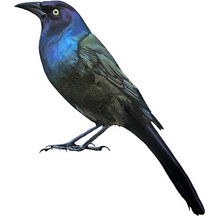
Brief Description: The Common Grackle is a lanky, highly adaptable blackbird recognizable by its glossy, iridescent plumage, bright yellow eyes, and long, keel-shaped tail. Often found foraging in noisy flocks across North America, they are opportunistic omnivores known for their harsh, mechanical calls that resemble a rusty gate hinge. Males are larger and feature a metallic, iridescent blue-purple head contrasting with bronze or green-glossed bodies. Females are slightly smaller and duller. Both sexes sport a heavy, sharp bill and pale eyes. Highly gregarious birds that form massive communal roosts. They are frequently seen foraging on lawns and around urban or suburban environments.
Plumage: Common Grackles appear as large, solid blackbirds from a distance, but in direct sunlight, their feathers exhibit vibrant iridescence. Males have glossy, metallic blue or purple heads and bronzy-brown bodies, while females are slightly smaller and duller brown. Both sexes feature piercing, pale golden-yellow eyes. Young birds are dark brown overall and have dark eyes instead of yellow.
Habitat: Grackles live throughout North, Central, and South America, as well as the Caribbean. In the United States and Canada, their exact location depends on the species, with the highly adaptable Common Grackle living east of the Rockies and Great-tailed Grackles and Boat-tailed Grackles dominating the southern and coastal regions. Found across North America east of the Rocky Mountains. They are common year-round in the Midwest and eastern U.S., while northern populations migrate to the Southeastern U.S. in the winter. They inhabit open woodlands, fields, swamps, and thrive in human-altered landscapes like city parks, golf courses, and suburban neighborhoods.
Egg & Nest Details: Common Grackles build bulky, messy open-cup nests of twigs, leaves, and grasses reinforced with mud and lined with fine material. Females lay clutches of 4-7 pale blue, pearl gray, or light brown eggs heavily splotched with dark brown marks. They are incubated for 11-15 days before fledging 10 to 17 days later. Outer layers are constructed from coarse twigs, weeds, and occasionally string or paper. The interior is a thick, sturdy cup of mud lined with fine grasses and hair. Placed in dense trees (especially conifers like pine) or thick shrubs, typically near water. They often nest in loose colonies containing anywhere from 30 up to 200 nests.
Diet: The common grackle is a highly resourceful omnivore. Its diet consists of agricultural grains and seeds (particularly corn), acorns, and fruits, alongside a significant amount of animal protein in the summer, including insects, spiders, small fish, frogs, mice, and even the eggs of other birds. Their primary diet during migration and winter is seeds and agricultural grains. In the spring and summer, up to 25% or more of their diet shifts to invertebrates and small vertebrates. Grackles will eat beetles, caterpillars, grasshoppers, earthworms, crayfish, and small amphibians. They are known to steal worms from other birds (like robins), scavenge human food and garbage.
Sounds: The Common Grackle produces a distinct, harsh mix of guttural squeaks, sharp whistles, and mechanical croaks. Their vocalizations are famous for sounding like a rusty gate hinge being forced open. Both males and females are active vocalists. A brief, rising, and metallic screech often phonetically written as "readle-eak" or "readle-ree". Lasts less than a single second. When singing, males hunker down, lean forward, puff out their feathers, spread their tails, and cock their wings in an intense, full-body display.
Brief Description: The Common Grackle is a lanky, highly adaptable blackbird recognizable by its glossy, iridescent plumage, bright yellow eyes, and long, keel-shaped tail. Often found foraging in noisy flocks across North America, they are opportunistic omnivores known for their harsh, mechanical calls that resemble a rusty gate hinge. Males are larger and feature a metallic, iridescent blue-purple head contrasting with bronze or green-glossed bodies. Females are slightly smaller and duller. Both sexes sport a heavy, sharp bill and pale eyes. Highly gregarious birds that form massive communal roosts. They are frequently seen foraging on lawns and around urban or suburban environments.
Plumage: Common Grackles appear as large, solid blackbirds from a distance, but in direct sunlight, their feathers exhibit vibrant iridescence. Males have glossy, metallic blue or purple heads and bronzy-brown bodies, while females are slightly smaller and duller brown. Both sexes feature piercing, pale golden-yellow eyes. Young birds are dark brown overall and have dark eyes instead of yellow.
Habitat: Grackles live throughout North, Central, and South America, as well as the Caribbean. In the United States and Canada, their exact location depends on the species, with the highly adaptable Common Grackle living east of the Rockies and Great-tailed Grackles and Boat-tailed Grackles dominating the southern and coastal regions. Found across North America east of the Rocky Mountains. They are common year-round in the Midwest and eastern U.S., while northern populations migrate to the Southeastern U.S. in the winter. They inhabit open woodlands, fields, swamps, and thrive in human-altered landscapes like city parks, golf courses, and suburban neighborhoods.
Egg & Nest Details: Common Grackles build bulky, messy open-cup nests of twigs, leaves, and grasses reinforced with mud and lined with fine material. Females lay clutches of 4-7 pale blue, pearl gray, or light brown eggs heavily splotched with dark brown marks. They are incubated for 11-15 days before fledging 10 to 17 days later. Outer layers are constructed from coarse twigs, weeds, and occasionally string or paper. The interior is a thick, sturdy cup of mud lined with fine grasses and hair. Placed in dense trees (especially conifers like pine) or thick shrubs, typically near water. They often nest in loose colonies containing anywhere from 30 up to 200 nests.
Diet: The common grackle is a highly resourceful omnivore. Its diet consists of agricultural grains and seeds (particularly corn), acorns, and fruits, alongside a significant amount of animal protein in the summer, including insects, spiders, small fish, frogs, mice, and even the eggs of other birds. Their primary diet during migration and winter is seeds and agricultural grains. In the spring and summer, up to 25% or more of their diet shifts to invertebrates and small vertebrates. Grackles will eat beetles, caterpillars, grasshoppers, earthworms, crayfish, and small amphibians. They are known to steal worms from other birds (like robins), scavenge human food and garbage.
Sounds: The Common Grackle produces a distinct, harsh mix of guttural squeaks, sharp whistles, and mechanical croaks. Their vocalizations are famous for sounding like a rusty gate hinge being forced open. Both males and females are active vocalists. A brief, rising, and metallic screech often phonetically written as "readle-eak" or "readle-ree". Lasts less than a single second. When singing, males hunker down, lean forward, puff out their feathers, spread their tails, and cock their wings in an intense, full-body display.