Brown-headed Cowbird
Return to visitors index
Scientific Name:
Molothrus ater
Brief Description: The Brown-headed Cowbird is a small, stocky North American bird in the blackbird family (Icteridae). They are most famous for being "obligate brood parasites," meaning they never build nests of their own. Instead, female cowbirds lay their eggs in the nests of other songbird species and leave the host parents to incubate the eggs and raise the young cowbirds, often at the expense of the host's own chicks. Measuring 6–8.7 inches in length , these birds are about the size of a sparrow or robin.
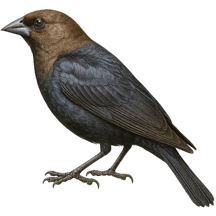
Plumage: Brown-headed Cowbirds males feature a chocolate-brown head and a glossy, iridescent black body that shimmers with greenish-blue under the sun. Both sexes have short, stout, finch-like bills and dark eyes. The body plumage is primarily black, but in bright light, the greenish to violet iridescence becomes visible. The head and neck contrast sharply as a solid brown. Females are drabber in appearance, their plumage is solid grayish-brown or tan above, fading to a lighter tone on the throat and underparts. They are entirely unmarked on the throat and chest, but feature very fine, dark streaks on the belly .
Habitat: Brown-headed Cowbirds thrive in open and semi-open landscapes like fields, pastures, woodland edges, and residential neighborhoods. Because they are brood parasites, their habitats must include both rich, short-grass foraging areas where they can find seeds and insects, and adjacent trees where females can watch for host nests. Historically native to the Great Plains and associated with bison, cowbird populations have vastly expanded across North America due to agricultural development and forest fragmentation. The intersection of livestock pastures and woodlands provides them with ideal conditions.
Egg & Nest Details: Brown-headed Cowbirds are brood parasites; they build no nests and instead lay their eggs in the nests of over 220 other songbird species . Female cowbirds secretly deposit single, speckled eggs into host nests, frequently removing or destroying a host egg in the process. Because the Brown-headed Cowbird is a native species, it is protected under the Migratory Bird Treaty Act. Removing their eggs from a nest is generally illegal without a permit, and interference can cause the host parents to abandon their nest entirely. The eggs are whitish or grayish-white, heavily marked with brown or gray spots and streaks . They typically hatch in 10 to 12 days—often faster than the host's own eggs.
Diet: They frequently forage on the ground in pastures, relying on grazing animals to stir up insects. Females also eat snail shells for calcium. Roughly three-quarters of their diet consists of weed seeds, grass seeds, and crop grains like wheat, oats, and corn. At backyard feeders, they are highly attracted to sunflower seeds, cracked corn, and millet. The remaining 25% consists of arthropods such as grasshoppers, beetles, leafhoppers, caterpillars, spiders, and occasionally slow-flying insects they catch in the air.
Sounds: The Brown-headed Cowbird produces a highly distinct, electronic, and liquid-sounding vocalization that famously resembles a dripping drop of water. short series of low, bubbling gurgles followed by a high-pitched, sliding whistle. It is often written out as a quick, watery "glug-glug-glee". Females make a distinct, rapid, mechanical clicking or rattling chatter. This rattling noise is highly attractive to males. Both sexes make clear, sweeping whistles (often 2 to 5 notes long) while flying, which sometimes end in a buzz or trill.
Brief Description: The Brown-headed Cowbird is a small, stocky North American bird in the blackbird family (Icteridae). They are most famous for being "obligate brood parasites," meaning they never build nests of their own. Instead, female cowbirds lay their eggs in the nests of other songbird species and leave the host parents to incubate the eggs and raise the young cowbirds, often at the expense of the host's own chicks. Measuring 6–8.7 inches in length , these birds are about the size of a sparrow or robin.
Plumage: Brown-headed Cowbirds males feature a chocolate-brown head and a glossy, iridescent black body that shimmers with greenish-blue under the sun. Both sexes have short, stout, finch-like bills and dark eyes. The body plumage is primarily black, but in bright light, the greenish to violet iridescence becomes visible. The head and neck contrast sharply as a solid brown. Females are drabber in appearance, their plumage is solid grayish-brown or tan above, fading to a lighter tone on the throat and underparts. They are entirely unmarked on the throat and chest, but feature very fine, dark streaks on the belly .
Habitat: Brown-headed Cowbirds thrive in open and semi-open landscapes like fields, pastures, woodland edges, and residential neighborhoods. Because they are brood parasites, their habitats must include both rich, short-grass foraging areas where they can find seeds and insects, and adjacent trees where females can watch for host nests. Historically native to the Great Plains and associated with bison, cowbird populations have vastly expanded across North America due to agricultural development and forest fragmentation. The intersection of livestock pastures and woodlands provides them with ideal conditions.
Egg & Nest Details: Brown-headed Cowbirds are brood parasites; they build no nests and instead lay their eggs in the nests of over 220 other songbird species . Female cowbirds secretly deposit single, speckled eggs into host nests, frequently removing or destroying a host egg in the process. Because the Brown-headed Cowbird is a native species, it is protected under the Migratory Bird Treaty Act. Removing their eggs from a nest is generally illegal without a permit, and interference can cause the host parents to abandon their nest entirely. The eggs are whitish or grayish-white, heavily marked with brown or gray spots and streaks . They typically hatch in 10 to 12 days—often faster than the host's own eggs.
Diet: They frequently forage on the ground in pastures, relying on grazing animals to stir up insects. Females also eat snail shells for calcium. Roughly three-quarters of their diet consists of weed seeds, grass seeds, and crop grains like wheat, oats, and corn. At backyard feeders, they are highly attracted to sunflower seeds, cracked corn, and millet. The remaining 25% consists of arthropods such as grasshoppers, beetles, leafhoppers, caterpillars, spiders, and occasionally slow-flying insects they catch in the air.
Sounds: The Brown-headed Cowbird produces a highly distinct, electronic, and liquid-sounding vocalization that famously resembles a dripping drop of water. short series of low, bubbling gurgles followed by a high-pitched, sliding whistle. It is often written out as a quick, watery "glug-glug-glee". Females make a distinct, rapid, mechanical clicking or rattling chatter. This rattling noise is highly attractive to males. Both sexes make clear, sweeping whistles (often 2 to 5 notes long) while flying, which sometimes end in a buzz or trill.