Brown Thrasher
Return to visitors index
Scientific Name:
Toxostoma rufum
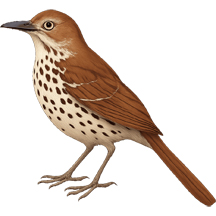
Brief Description: The Brown Thrasher is a robin-sized songbird recognized by its bright reddish-brown (rufous) back, long tail, striking yellow eyes, and heavily streaked white breast. Known for its loud, elaborate songs and secretive behavior, it uses its long, down-curved bill to dig through leaf litter for insects.
Key Identification Features
Size & Shape: Large songbird (about 11.5 inches long) with a very long, rounded tail and a long, slender, down-curved bill.
Distinctive Traits: Striking, piercing yellow eyes.
Plumage: The Brown Thrasher features bright, rich reddish-brown upperparts, a long rufous tail, and two distinct black-and-white wing bars. Their underparts are white to buff, heavily marked with dark brown, teardrop-shaped streaks. Key field marks include a long, slightly down-curved bill and piercing yellow eyes.
Detailed Plumage Breakdown:
Upperparts: The head, nape, back, and wings are a foxy, rich reddish-brown.
Wings: The median and greater wing coverts are tipped with white, forming two distinct, narrow wing bars.
Underparts: The chest and flanks are creamy white or buffy, decorated with bold, dark brown, teardrop-shaped streaks.
Tail: The tail is exceptionally long and rounded, with pale, buffy-white corners.
Face & Eyes: The cheeks are grayish, and they possess striking, bright amber-yellow eyes.
Habitat: Brown thrashers are secretive birds that inhabit dense brush, tangled thickets, hedgerows, and forest edges. They are primarily found throughout central and eastern North America, relying on dense undergrowth for cover and foraging. They spend most of their time on the ground excavating leaf litter with their bills. Dense Cover: Tangled shrubs, thorn scrub, and overgrown clearings are essential for nesting and escaping predators. Nests are typically built in dense vegetation or low, thorny trees about 1 to 2 meters off the ground. Leaf Litter: They rely heavily on deciduous forests, shelterbelts, and woody draws that have ample dry leaves and soil to scratch through for insects, seeds, and berries. Backyards and Urban Areas: They can be found in residential and agricultural areas that feature thick shrubbery, fruit-producing bushes, and ground cover.
Egg & Nest Details: Brown Thrashers construct bulky, cup-shaped nests out of twigs, dead leaves, and grass, usually hidden low in dense, thorny shrubs or occasionally on the ground. The female lays a clutch of 3 to 5 glossy pale blue, greenish-blue, or white eggs heavily speckled with reddish-brown. Nest Construction: Both the male and female participate in building the nest. It features a firm twig foundation lined with fine grass, rootlets, and leaves, measuring about 8 to 12 inches across. Nest Location: Typically placed 2 to 7 feet above the ground in thorny bushes (like hawthorn, multiflora rose, or holly), tangles, or small trees, but they will sometimes nest directly on the ground.
Diet: Brown Thrashers are omnivores that forage primarily on the ground. Over half of their diet consists of insects (like beetles, caterpillars, and grasshoppers), while the remainder includes earthworms, berries, acorns, and sometimes small lizards or frogs. Because of their distinct, slightly curved bills, Brown Thrashers spend most of their time rummaging through leaf litter. They use a "thrashing" motion to sweep debris aside and expose hidden insects. Their typical diet includes: Beetles, caterpillars, grasshoppers, cicadas, spiders, earthworms, snails, and crayfish. Vertebrates: Occasionally small lizards, frogs, and very small snakes. Fruits & Nuts: Berries, wild grapes, cherries, and acorns (which they can crack open by pounding with their bill).
Sounds: The Brown Thrasher is one of North America's most exuberant and varied songbirds, possessing a massive vocabulary that boasts over 1,100 different song types. They are best known by birdwatchers for their doubly repetitive song structure—they will sing a melodic phrase or mimicry, and then immediately repeat it twice before moving on to the next sound.Their vocalizations can be broken down into two main categories: their rich, rambling songs and their sharp, scolding calls. The Pattern: Unlike the Northern Mockingbird (which repeats phrases three or more times) or the Gray Catbird (which sings each phrase only once), the Brown Thrasher sings its phrases in distinct pairs. Mimicry: Like their mockingbird and catbird cousins, they are accomplished mimics. They frequently weave raw imitations of other bird species (such as the Northern Flicker, Wood Thrush, and Tufted Titmouse) into their improvisational melodies.
Brief Description: The Brown Thrasher is a robin-sized songbird recognized by its bright reddish-brown (rufous) back, long tail, striking yellow eyes, and heavily streaked white breast. Known for its loud, elaborate songs and secretive behavior, it uses its long, down-curved bill to dig through leaf litter for insects.
Key Identification Features
Size & Shape: Large songbird (about 11.5 inches long) with a very long, rounded tail and a long, slender, down-curved bill.
Distinctive Traits: Striking, piercing yellow eyes.
Plumage: The Brown Thrasher features bright, rich reddish-brown upperparts, a long rufous tail, and two distinct black-and-white wing bars. Their underparts are white to buff, heavily marked with dark brown, teardrop-shaped streaks. Key field marks include a long, slightly down-curved bill and piercing yellow eyes.
Detailed Plumage Breakdown:
Upperparts: The head, nape, back, and wings are a foxy, rich reddish-brown.
Wings: The median and greater wing coverts are tipped with white, forming two distinct, narrow wing bars.
Underparts: The chest and flanks are creamy white or buffy, decorated with bold, dark brown, teardrop-shaped streaks.
Tail: The tail is exceptionally long and rounded, with pale, buffy-white corners.
Face & Eyes: The cheeks are grayish, and they possess striking, bright amber-yellow eyes.
Habitat: Brown thrashers are secretive birds that inhabit dense brush, tangled thickets, hedgerows, and forest edges. They are primarily found throughout central and eastern North America, relying on dense undergrowth for cover and foraging. They spend most of their time on the ground excavating leaf litter with their bills. Dense Cover: Tangled shrubs, thorn scrub, and overgrown clearings are essential for nesting and escaping predators. Nests are typically built in dense vegetation or low, thorny trees about 1 to 2 meters off the ground. Leaf Litter: They rely heavily on deciduous forests, shelterbelts, and woody draws that have ample dry leaves and soil to scratch through for insects, seeds, and berries. Backyards and Urban Areas: They can be found in residential and agricultural areas that feature thick shrubbery, fruit-producing bushes, and ground cover.
Egg & Nest Details: Brown Thrashers construct bulky, cup-shaped nests out of twigs, dead leaves, and grass, usually hidden low in dense, thorny shrubs or occasionally on the ground. The female lays a clutch of 3 to 5 glossy pale blue, greenish-blue, or white eggs heavily speckled with reddish-brown. Nest Construction: Both the male and female participate in building the nest. It features a firm twig foundation lined with fine grass, rootlets, and leaves, measuring about 8 to 12 inches across. Nest Location: Typically placed 2 to 7 feet above the ground in thorny bushes (like hawthorn, multiflora rose, or holly), tangles, or small trees, but they will sometimes nest directly on the ground.
Diet: Brown Thrashers are omnivores that forage primarily on the ground. Over half of their diet consists of insects (like beetles, caterpillars, and grasshoppers), while the remainder includes earthworms, berries, acorns, and sometimes small lizards or frogs. Because of their distinct, slightly curved bills, Brown Thrashers spend most of their time rummaging through leaf litter. They use a "thrashing" motion to sweep debris aside and expose hidden insects. Their typical diet includes: Beetles, caterpillars, grasshoppers, cicadas, spiders, earthworms, snails, and crayfish. Vertebrates: Occasionally small lizards, frogs, and very small snakes. Fruits & Nuts: Berries, wild grapes, cherries, and acorns (which they can crack open by pounding with their bill).
Sounds: The Brown Thrasher is one of North America's most exuberant and varied songbirds, possessing a massive vocabulary that boasts over 1,100 different song types. They are best known by birdwatchers for their doubly repetitive song structure—they will sing a melodic phrase or mimicry, and then immediately repeat it twice before moving on to the next sound.Their vocalizations can be broken down into two main categories: their rich, rambling songs and their sharp, scolding calls. The Pattern: Unlike the Northern Mockingbird (which repeats phrases three or more times) or the Gray Catbird (which sings each phrase only once), the Brown Thrasher sings its phrases in distinct pairs. Mimicry: Like their mockingbird and catbird cousins, they are accomplished mimics. They frequently weave raw imitations of other bird species (such as the Northern Flicker, Wood Thrush, and Tufted Titmouse) into their improvisational melodies.