White-crowned Sparrow
Return to visitors index
Scientific Name:
Zonotrichia leucophrys
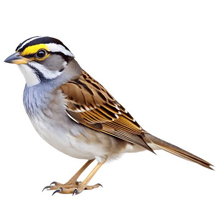
Brief Description: The White-crowned Sparrow is a large, crisp sparrow distinguished by bold black-and-white head stripes, a clear gray breast, and a distinct pale pink or yellowish bill. Measuring about 6 inches in length, these spirited birds forage on the ground near dense brush and are renowned for their sweet, whistling songs. They are often confused with the White-throated Sparrow. You can tell them apart because the White-crowned Sparrow lacks a distinct white throat patch and has no yellow spot between its bill and eye.
Plumage: Adult White-crowned Sparrows feature bold black-and-white crown stripes, a clear gray breast, and a pink or yellowish bill. Juveniles are heavily streaked with brown head stripes. In their first winter, immatures display muted tan and brown stripes, transitioning to the striking adult plumage the following spring. Adults: Head has alternating black and white stripes. The back and wings are reddish-brown with two prominent white wing-bars. The breast, face, and neck are plain pearly-gray. Immatures (First Winter): The crisp black-and-white head pattern is replaced with muted brown and tan stripes. Their back and wings are duller, and the breast shows a light brownish wash. Juveniles: Distinctively different, juveniles have heavy black streaks on their buffy-brown breast and a dull, mottled brown head.
Habitat: White-crowned Sparrows thrive in brushy habitats, forest edges, and scrublands across North America. During the breeding season, they prefer the tundra, alpine meadows, and taiga. In the winter and during migration, they relocate to agricultural fields, roadsides, hedgerows, and weedy backyard thickets. In the summer, they require environments that provide a mix of dense shrubs for nesting or cover and patches of bare ground or grasses for foraging. Northern breeding populations migrate south for the winter, while some coastal and western populations remain year-round. Wintering habitats are typically more open.
Egg & Nest Details: White-crowned Sparrow nests are open cups woven by females from twigs, grasses, and bark, then lined with animal hair. They lay clutches of 3 to 7 pale greenish or bluish eggs, thickly spotted with reddish-brown. Incubation takes 10 to 14 days, with both parents subsequently raising the hatchlings. Females are responsible for both building the nest (which takes 2 to 10 days) and incubating the eggs. Nest locations vary depending on the habitat. Young birds leave the nest quickly, usually within 8 to 11 days after hatching, although they cannot fly for another week. Both parents participate in feeding the chicks.
Diet: White-crowned Sparrows are opportunistic foragers that primarily eat seeds, insects, buds, and berries. Their diet shifts with the seasons: in the summer, they eat more insects (like caterpillars and beetles), while in the winter, they rely heavily on the seeds of weeds, grasses, and agricultural grains. Insects: Especially prevalent in the summer and breeding season; young nestlings are fed almost exclusively insects. In the winter, they eat grass and weed seeds, as well as grains like oats, wheat, and corn. They also eat green plant materials, including buds, flowers, and even leaves. They regularly consume small fruits and berries like elderberries and blackberries. At feeders, they prefer millet, sunflower chips, and black oil sunflower seeds, typically eaten from ground-level trays or directly off the ground.
Sounds: The White-crowned Sparrow is famous for its sweet, whistling song followed by a distinctive buzzy trill. It is one of the most heavily studied sounds in animal behavior because the birds develop distinct regional dialects based on where they learn their songs. The Primary Song: Lasts about 2 to 3 seconds. It starts with a clear, sweet whistling introduction, moves into a succession of jumbled whistles, and finishes with a distinct buzz or trill.
Brief Description: The White-crowned Sparrow is a large, crisp sparrow distinguished by bold black-and-white head stripes, a clear gray breast, and a distinct pale pink or yellowish bill. Measuring about 6 inches in length, these spirited birds forage on the ground near dense brush and are renowned for their sweet, whistling songs. They are often confused with the White-throated Sparrow. You can tell them apart because the White-crowned Sparrow lacks a distinct white throat patch and has no yellow spot between its bill and eye.
Plumage: Adult White-crowned Sparrows feature bold black-and-white crown stripes, a clear gray breast, and a pink or yellowish bill. Juveniles are heavily streaked with brown head stripes. In their first winter, immatures display muted tan and brown stripes, transitioning to the striking adult plumage the following spring. Adults: Head has alternating black and white stripes. The back and wings are reddish-brown with two prominent white wing-bars. The breast, face, and neck are plain pearly-gray. Immatures (First Winter): The crisp black-and-white head pattern is replaced with muted brown and tan stripes. Their back and wings are duller, and the breast shows a light brownish wash. Juveniles: Distinctively different, juveniles have heavy black streaks on their buffy-brown breast and a dull, mottled brown head.
Habitat: White-crowned Sparrows thrive in brushy habitats, forest edges, and scrublands across North America. During the breeding season, they prefer the tundra, alpine meadows, and taiga. In the winter and during migration, they relocate to agricultural fields, roadsides, hedgerows, and weedy backyard thickets. In the summer, they require environments that provide a mix of dense shrubs for nesting or cover and patches of bare ground or grasses for foraging. Northern breeding populations migrate south for the winter, while some coastal and western populations remain year-round. Wintering habitats are typically more open.
Egg & Nest Details: White-crowned Sparrow nests are open cups woven by females from twigs, grasses, and bark, then lined with animal hair. They lay clutches of 3 to 7 pale greenish or bluish eggs, thickly spotted with reddish-brown. Incubation takes 10 to 14 days, with both parents subsequently raising the hatchlings. Females are responsible for both building the nest (which takes 2 to 10 days) and incubating the eggs. Nest locations vary depending on the habitat. Young birds leave the nest quickly, usually within 8 to 11 days after hatching, although they cannot fly for another week. Both parents participate in feeding the chicks.
Diet: White-crowned Sparrows are opportunistic foragers that primarily eat seeds, insects, buds, and berries. Their diet shifts with the seasons: in the summer, they eat more insects (like caterpillars and beetles), while in the winter, they rely heavily on the seeds of weeds, grasses, and agricultural grains. Insects: Especially prevalent in the summer and breeding season; young nestlings are fed almost exclusively insects. In the winter, they eat grass and weed seeds, as well as grains like oats, wheat, and corn. They also eat green plant materials, including buds, flowers, and even leaves. They regularly consume small fruits and berries like elderberries and blackberries. At feeders, they prefer millet, sunflower chips, and black oil sunflower seeds, typically eaten from ground-level trays or directly off the ground.
Sounds: The White-crowned Sparrow is famous for its sweet, whistling song followed by a distinctive buzzy trill. It is one of the most heavily studied sounds in animal behavior because the birds develop distinct regional dialects based on where they learn their songs. The Primary Song: Lasts about 2 to 3 seconds. It starts with a clear, sweet whistling introduction, moves into a succession of jumbled whistles, and finishes with a distinct buzz or trill.