Ruby-throated Hummingbird
Return to visitors index
Scientific Name:
Archilochus colubris
Brief Description: The Ruby-throated Hummingbird is the only species of hummingbird that regularly breeds in eastern North America. These tiny, agile birds measure just 2.8 to 3.5 inches in length with a wingspan of 3 to 4.3 inches, and weigh about 2 to 6 grams (roughly the weight of a penny). Behaviorally, they are renowned for their exceptional hovering abilities, beating their wings up to 80 times per second to maneuver in all directions, including backward.
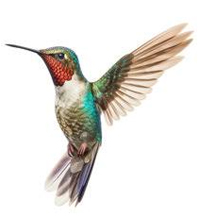
Plumage: Males have bright emerald-green backs and a brilliant, iridescent ruby-red throat patch (gorget). Females are slightly larger with duller, golden-green upperparts, a solid white throat, and a rounded tail featuring white-tipped outer feathers. Male Plumage Upperparts: Deep, metallic emerald to golden-green on the crown and back. Throat (Gorget): Velvety black underneath with brilliant, iridescent ruby-red feathers. This red coloration is not a pigment but the result of light refraction; the throat can appear completely black until the bird tilts its head in the sun. Underparts: Dull white chest that becomes grayish-brown on the abdomen, with dark, metallic bronze-green sides and flanks. Tail: Dark, near-black, and deeply forked without white tips. Both sexes possess striking, puffy white tufts at the base of their legs (femoral tufts) and a small, distinct white spot located just behind the eye.
Habitat: Ruby-throated hummingbirds thrive in open deciduous woodlands, forest edges, orchards, and flower-rich suburban gardens. They require abundant nectar sources, nearby trees for nesting, and water. During winter in Central America, they migrate to tropical dry forests and citrus groves. Breeding Season (Summer): In the eastern United States and southern Canada, they are commonly found in deciduous forests, old fields, and parks. They seek out areas with abundant tubular flowers (such as honeysuckle, jewelweed, and bee balm) and flying insects. Wintering Grounds: From late fall to early spring, they migrate to Mexico, Central America, and parts of Florida. In these regions, they frequent shade-grown coffee farms, tropical scrub landscapes, forest edges, and citrus groves.
Egg & Nest Details: Ruby-throated Hummingbird nests are tiny, thimble-sized cups built by females using plant down and spiderwebs, and camouflaged with lichen. She lays a clutch of 1 to 3 white eggs, each about the size of a coffee bean or navy bean. The incubation period is 12 to 14 days. Size and Shape: About 2 inches across and 1 inch deep, comparable to half an English walnut shell. Materials: Built primarily from thistle or dandelion down, woven tightly with sticky spider silk, and decorated on the outside with lichen and moss to blend into the tree branch. Placement: The female constructs the nest 10 to 40 feet above the ground on a slender, often downward-sloping deciduous tree branch (like oak, birch, or poplar).The Eggs Size: Approximately 0.5 to 0.6 inches long and 0.3 inches wide. Appearance: Tiny, pure white, and weigh less than half a gram each.
Diet: Ruby-throated hummingbirds primarily consume floral nectar for quick energy, but also eat small insects and spiders for protein. To sustain their rapid metabolism, they feed 5 to 6 times per hour, often consuming their entire body weight in food daily. Their specific diet consists of: Nectar: They heavily favor red or orange tubular flowers, such as trumpet creepers, cardinal flowers, honeysuckle, and bee-balm. They also readily drink from artificial feeders containing a simple 1:4 sugar water mixture. They hunt tiny bugs—like mosquitoes, gnats, fruit flies, and aphids—in midair or pluck them directly from leaves and spiderwebs. Occasionally, they sip tree sap from wells made by sapsucker birds when nectar is scarce.
Sounds: Ruby-throated Hummingbirds make two primary types of sounds: vocal chattering calls and mechanical wing hums. While they do not produce elaborate, musical songs like songbirds, they are highly vocal and expressive, especially when defending territory or interacting at feeders. The "Chee-dit" Chase Call: This is an even, rapid chee-dit sound exchanged between birds. It is most frequently heard during aggressive high-speed aerial chases or disputes over feeding territories. At daybreak, males often broadcast a constant series of simple, repetitive chips. When multiple birds crowd a feeder, they release rapid, high-pitched, metallic chattering noises to establish a dominance hierarchy.
Brief Description: The Ruby-throated Hummingbird is the only species of hummingbird that regularly breeds in eastern North America. These tiny, agile birds measure just 2.8 to 3.5 inches in length with a wingspan of 3 to 4.3 inches, and weigh about 2 to 6 grams (roughly the weight of a penny). Behaviorally, they are renowned for their exceptional hovering abilities, beating their wings up to 80 times per second to maneuver in all directions, including backward.
Plumage: Males have bright emerald-green backs and a brilliant, iridescent ruby-red throat patch (gorget). Females are slightly larger with duller, golden-green upperparts, a solid white throat, and a rounded tail featuring white-tipped outer feathers. Male Plumage Upperparts: Deep, metallic emerald to golden-green on the crown and back. Throat (Gorget): Velvety black underneath with brilliant, iridescent ruby-red feathers. This red coloration is not a pigment but the result of light refraction; the throat can appear completely black until the bird tilts its head in the sun. Underparts: Dull white chest that becomes grayish-brown on the abdomen, with dark, metallic bronze-green sides and flanks. Tail: Dark, near-black, and deeply forked without white tips. Both sexes possess striking, puffy white tufts at the base of their legs (femoral tufts) and a small, distinct white spot located just behind the eye.
Habitat: Ruby-throated hummingbirds thrive in open deciduous woodlands, forest edges, orchards, and flower-rich suburban gardens. They require abundant nectar sources, nearby trees for nesting, and water. During winter in Central America, they migrate to tropical dry forests and citrus groves. Breeding Season (Summer): In the eastern United States and southern Canada, they are commonly found in deciduous forests, old fields, and parks. They seek out areas with abundant tubular flowers (such as honeysuckle, jewelweed, and bee balm) and flying insects. Wintering Grounds: From late fall to early spring, they migrate to Mexico, Central America, and parts of Florida. In these regions, they frequent shade-grown coffee farms, tropical scrub landscapes, forest edges, and citrus groves.
Egg & Nest Details: Ruby-throated Hummingbird nests are tiny, thimble-sized cups built by females using plant down and spiderwebs, and camouflaged with lichen. She lays a clutch of 1 to 3 white eggs, each about the size of a coffee bean or navy bean. The incubation period is 12 to 14 days. Size and Shape: About 2 inches across and 1 inch deep, comparable to half an English walnut shell. Materials: Built primarily from thistle or dandelion down, woven tightly with sticky spider silk, and decorated on the outside with lichen and moss to blend into the tree branch. Placement: The female constructs the nest 10 to 40 feet above the ground on a slender, often downward-sloping deciduous tree branch (like oak, birch, or poplar).The Eggs Size: Approximately 0.5 to 0.6 inches long and 0.3 inches wide. Appearance: Tiny, pure white, and weigh less than half a gram each.
Diet: Ruby-throated hummingbirds primarily consume floral nectar for quick energy, but also eat small insects and spiders for protein. To sustain their rapid metabolism, they feed 5 to 6 times per hour, often consuming their entire body weight in food daily. Their specific diet consists of: Nectar: They heavily favor red or orange tubular flowers, such as trumpet creepers, cardinal flowers, honeysuckle, and bee-balm. They also readily drink from artificial feeders containing a simple 1:4 sugar water mixture. They hunt tiny bugs—like mosquitoes, gnats, fruit flies, and aphids—in midair or pluck them directly from leaves and spiderwebs. Occasionally, they sip tree sap from wells made by sapsucker birds when nectar is scarce.
Sounds: Ruby-throated Hummingbirds make two primary types of sounds: vocal chattering calls and mechanical wing hums. While they do not produce elaborate, musical songs like songbirds, they are highly vocal and expressive, especially when defending territory or interacting at feeders. The "Chee-dit" Chase Call: This is an even, rapid chee-dit sound exchanged between birds. It is most frequently heard during aggressive high-speed aerial chases or disputes over feeding territories. At daybreak, males often broadcast a constant series of simple, repetitive chips. When multiple birds crowd a feeder, they release rapid, high-pitched, metallic chattering noises to establish a dominance hierarchy.