Purple Finch
Return to visitors index
Scientific Name:
Haemorhous purpureus
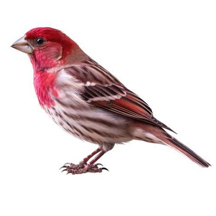
Brief Description: The Purple Finch is a small, chunky North American songbird famously described by ornithologist Roger Tory Peterson as a "sparrow dipped in raspberry juice." Despite their name, they are not truly purple, but exhibit a rich, wine-red or rose-pink coloration. They are stocky, sparrow-sized birds measuring 4.7 to 6.3 inches (12 to 16 cm) in length with a heavy, conical seed-cracking beak and a distinctly notched tail. It is very easy to confuse the Purple Finch with the more common House Finch. Think of it like comparing a slightly messy watercolor painting (Purple Finch) to a drawing with strict lines (House Finch).
Plumage: Adult male Purple Finches display a raspberry-red plumage on the head, breast, and back. Females and young males lack this red color. They have brown backs and white underparts with dark, blurry streaks. They also show a bold, white stripe above their eyes. Adult Males: The feathers look like a bird dipped in raspberry juice. They have pinkish-red edges on their brown wings and tails. Their bright color comes from pigments in their food during molting. Females & Immatures: They look like typical sparrows. Their plumage acts as camouflage to hide them from predators while they sit on nests. Both sexes replace their feathers once a year, usually in late summer. Young males wear the brown female plumage for about a year before growing their first red feathers.
Habitat: Purple Finches live in northern forests, wetlands, and suburbs across North America. During the summer, they breed in moist evergreen and mixed woods. During the winter, they move south to find food. In winter, you can spot them in open fields, parks, and leafy neighborhoods. Breeding Season: They prefer dense pine, spruce, and fir forests. They build nests on horizontal tree branches, often hidden under thicker leaves to stay safe. Wintering Season: They follow food sources. You can find them in orchards, weedy fields, and forests.
Egg & Nest Details: Purple Finch nests are cup-shaped structures of twigs, weeds, and moss, lined with fine grass and animal hair. They typically hold 2 to 7 pale blue-green eggs marked with dark speckles. The female incubates them for about 13 days. Nest Construction: Built far out on the branch of a coniferous tree or under an overhanging branch for shelter. In the southern breeding range, they may use deciduous trees like oak, maple, or cherry. The female takes about 3 to 8 days to build the nest, using twigs and roots for the base and lining the cup for softness. Completed nests are about 7 inches wide and 4 inches tall.
Diet: Purple Finches eat a varied diet consisting primarily of tree and weed seeds, soft flower buds, berries, and insects. In the wild, they are especially fond of seeds from coniferous trees, elms, and maples, as well as insects like caterpillars and beetles. At backyard feeders, their top choice is black oil sunflower seeds. Their adaptable, heavy-duty beaks allow them to forage for a wide range of foods across the seasons. To attract them to your yard, you can offer black oil sunflower seeds in tube feeders or tray feeders.
Sounds: The Purple Finch produces a fast, rich, and smoothly rolling warble that completely lacks the sharp, buzzy notes of its close relative, the House Finch. Their vocalizations are highly musical and distinct depending on their context. When identifying these birds by ear, listen carefully to the texture of the sound: Purple Finch: Faster, fluid, purely musical phrases that roll smoothly. House Finch: Slower, rougher, and jumbled, heavily tagged with a signature raspy, upward-slurred "buzzy" note at the end.
Brief Description: The Purple Finch is a small, chunky North American songbird famously described by ornithologist Roger Tory Peterson as a "sparrow dipped in raspberry juice." Despite their name, they are not truly purple, but exhibit a rich, wine-red or rose-pink coloration. They are stocky, sparrow-sized birds measuring 4.7 to 6.3 inches (12 to 16 cm) in length with a heavy, conical seed-cracking beak and a distinctly notched tail. It is very easy to confuse the Purple Finch with the more common House Finch. Think of it like comparing a slightly messy watercolor painting (Purple Finch) to a drawing with strict lines (House Finch).
Plumage: Adult male Purple Finches display a raspberry-red plumage on the head, breast, and back. Females and young males lack this red color. They have brown backs and white underparts with dark, blurry streaks. They also show a bold, white stripe above their eyes. Adult Males: The feathers look like a bird dipped in raspberry juice. They have pinkish-red edges on their brown wings and tails. Their bright color comes from pigments in their food during molting. Females & Immatures: They look like typical sparrows. Their plumage acts as camouflage to hide them from predators while they sit on nests. Both sexes replace their feathers once a year, usually in late summer. Young males wear the brown female plumage for about a year before growing their first red feathers.
Habitat: Purple Finches live in northern forests, wetlands, and suburbs across North America. During the summer, they breed in moist evergreen and mixed woods. During the winter, they move south to find food. In winter, you can spot them in open fields, parks, and leafy neighborhoods. Breeding Season: They prefer dense pine, spruce, and fir forests. They build nests on horizontal tree branches, often hidden under thicker leaves to stay safe. Wintering Season: They follow food sources. You can find them in orchards, weedy fields, and forests.
Egg & Nest Details: Purple Finch nests are cup-shaped structures of twigs, weeds, and moss, lined with fine grass and animal hair. They typically hold 2 to 7 pale blue-green eggs marked with dark speckles. The female incubates them for about 13 days. Nest Construction: Built far out on the branch of a coniferous tree or under an overhanging branch for shelter. In the southern breeding range, they may use deciduous trees like oak, maple, or cherry. The female takes about 3 to 8 days to build the nest, using twigs and roots for the base and lining the cup for softness. Completed nests are about 7 inches wide and 4 inches tall.
Diet: Purple Finches eat a varied diet consisting primarily of tree and weed seeds, soft flower buds, berries, and insects. In the wild, they are especially fond of seeds from coniferous trees, elms, and maples, as well as insects like caterpillars and beetles. At backyard feeders, their top choice is black oil sunflower seeds. Their adaptable, heavy-duty beaks allow them to forage for a wide range of foods across the seasons. To attract them to your yard, you can offer black oil sunflower seeds in tube feeders or tray feeders.
Sounds: The Purple Finch produces a fast, rich, and smoothly rolling warble that completely lacks the sharp, buzzy notes of its close relative, the House Finch. Their vocalizations are highly musical and distinct depending on their context. When identifying these birds by ear, listen carefully to the texture of the sound: Purple Finch: Faster, fluid, purely musical phrases that roll smoothly. House Finch: Slower, rougher, and jumbled, heavily tagged with a signature raspy, upward-slurred "buzzy" note at the end.