American Robin
Return to visitors index
Scientific Name:
Turdus migratorius
Brief Description: The American Robin is a common, migratory North American songbird known for its warm, brick-red to orange breast, dark grey back, and cheerful, liquid song. Highly familiar on suburban lawns, they are famous for visually hunting earthworms in the early morning. Size & Shape: Large thrushes (about 8–11 inches long) with a wingspan of up to 16 inches, plump bodies, and long tails.
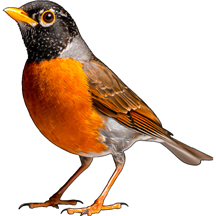
Plumage: The American Robin has a gray-brown back, dark head and tail, and a rust-orange chest . Males have darker black heads and brighter red chests, while females are paler. Juveniles feature spotted breasts and mottled backs. Key traits include a yellow bill and a white broken eye ring. The throat is white streaked with black and have a broken white eye ring (a white crescent above and below the eye). The dark tail has noticeable white corners, which are especially visible when the bird is in flight. The bill is predominantly yellow with a dark tip (which may become darker in winter) , and the legs and feet are brown.
Habitat: American Robins thrive in a wide variety of habitats across North America, primarily requiring two main features: open, moist ground for foraging (such as lawns, fields, and parks), and dense trees or shrubs for nesting and roosting. During the spring and summer, American Robins are highly adaptable. While they originally nested exclusively in deep forests, they have successfully adapted to human-altered landscapes.
Egg & Nest Details: American Robins are famous for their sturdy, mud-bound nests and distinctive bright turquoise eggs. Female robins lay 3 to 5 eggs over consecutive days, incubating them for 12 to 14 days. The chicks hatch helpless and fledge just two weeks later. The female builds the nest, forming a sturdy cup shape out of twigs, coarse grass, and paper. She reinforces the structure with wet mud and finally lines it with fine, dry grass. Nests are typically placed on horizontal branches in the lower half of a tree. However, they frequently adapt to human environments, building nests in gutters, on outdoor light fixtures, or porch ledges. The completed nest spans about 6 to 8 inches across and 3 to 6 inches high, with an interior well about the size of a baseball.
Diet: The American Robin is an opportunistic omnivore with a diet that fluctuates by season and time of day. Overall, its diet consists of about 40% invertebrates—like earthworms and insects—and 60% wild and cultivated fruits. Juveniles are fed almost exclusively insects and worms. Fall and Winter: They transition to a mostly fruit-based diet, flocking to consume wild berries and tree fruits like hawthorn, holly, chokecherry, sumac, and juniper.
Sounds: The American Robin possesses a rich vocabulary of songs and calls, most famously characterized by its cheerful, string-like spring whistle that sounds like “cheerily, cheer up, cheer up, cheerily, cheer up”. As a member of the thrush family, its vocalizations are melodic, clear-toned, and rise and fall steadily in pitch.
Brief Description: The American Robin is a common, migratory North American songbird known for its warm, brick-red to orange breast, dark grey back, and cheerful, liquid song. Highly familiar on suburban lawns, they are famous for visually hunting earthworms in the early morning. Size & Shape: Large thrushes (about 8–11 inches long) with a wingspan of up to 16 inches, plump bodies, and long tails.
Plumage: The American Robin has a gray-brown back, dark head and tail, and a rust-orange chest . Males have darker black heads and brighter red chests, while females are paler. Juveniles feature spotted breasts and mottled backs. Key traits include a yellow bill and a white broken eye ring. The throat is white streaked with black and have a broken white eye ring (a white crescent above and below the eye). The dark tail has noticeable white corners, which are especially visible when the bird is in flight. The bill is predominantly yellow with a dark tip (which may become darker in winter) , and the legs and feet are brown.
Habitat: American Robins thrive in a wide variety of habitats across North America, primarily requiring two main features: open, moist ground for foraging (such as lawns, fields, and parks), and dense trees or shrubs for nesting and roosting. During the spring and summer, American Robins are highly adaptable. While they originally nested exclusively in deep forests, they have successfully adapted to human-altered landscapes.
Egg & Nest Details: American Robins are famous for their sturdy, mud-bound nests and distinctive bright turquoise eggs. Female robins lay 3 to 5 eggs over consecutive days, incubating them for 12 to 14 days. The chicks hatch helpless and fledge just two weeks later. The female builds the nest, forming a sturdy cup shape out of twigs, coarse grass, and paper. She reinforces the structure with wet mud and finally lines it with fine, dry grass. Nests are typically placed on horizontal branches in the lower half of a tree. However, they frequently adapt to human environments, building nests in gutters, on outdoor light fixtures, or porch ledges. The completed nest spans about 6 to 8 inches across and 3 to 6 inches high, with an interior well about the size of a baseball.
Diet: The American Robin is an opportunistic omnivore with a diet that fluctuates by season and time of day. Overall, its diet consists of about 40% invertebrates—like earthworms and insects—and 60% wild and cultivated fruits. Juveniles are fed almost exclusively insects and worms. Fall and Winter: They transition to a mostly fruit-based diet, flocking to consume wild berries and tree fruits like hawthorn, holly, chokecherry, sumac, and juniper.
Sounds: The American Robin possesses a rich vocabulary of songs and calls, most famously characterized by its cheerful, string-like spring whistle that sounds like “cheerily, cheer up, cheer up, cheerily, cheer up”. As a member of the thrush family, its vocalizations are melodic, clear-toned, and rise and fall steadily in pitch.