Mourning Dove
Return to visitors index
Scientific Name:
Zenaida macroura
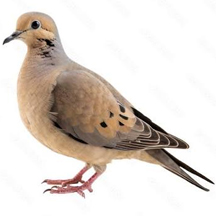
Brief Description: The Mourning Dove is a graceful, medium-sized bird, roughly 9 to 13 inches (23–33 cm) long with a 17-inch (43 cm) wingspan. Features a small, round head, a plump body, a delicate black bill, and short pinkish-red legs. Long, tapered, and sharply pointed, bordered with distinctive white outer feathers visible in flight. Large, dark brown eyes uniquely encircled by a ring of vivid light-blue bare skin. When taking off or landing, their wings produce a sharp, high-pitched whistling or whinnying sound used to alert other birds of danger. Despite looking plump when resting, they are aerodynamic, powerful fliers capable of speeds up to 55 mph (88 km/h).
Plumage: Mourning Doves have soft, muted plumage, mostly light grayish-brown and buff. Their wings feature distinct black spots. They have long, pointed tails with white edges. Males have a bluish-gray cap and a pink, iridescent neck. Females are browner and duller. Juveniles look scaly with pale feather tips. While the sexes look similar, you can tell them apart if you look closely in bright light. Males: They have a striking bluish-gray cap on the very top of their heads. Their chests are more rosy or pink, and the sides of their necks shimmer with purple and pink iridescence. Females: They are much duller and browner overall. Their crowns are typically brown, and they lack the bright shimmering colors on the neck.
Habitat: Mourning Doves live in open and semi-open areas like farmlands, suburbs, and grasslands. They love "edge" habitats where woods meet open spaces. You will often find them on power lines or the ground gathering seeds. They avoid thick, unbroken forests. Food: They eat 99% seeds. They look for grains like corn and wheat, plus weed seeds, on bare dirt or short grass. They like man-made structures because they offer better safety from weather and predators. They prefer drinking from the edges of shallow ponds, but can also tolerate slightly salty water in dry desert areas.
Egg & Nest Details: Mourning doves are known for building notoriously flimsy, loose nests out of twigs and pine needles, often in trees, shrubs, or on building ledges. They almost always lay a clutch of exactly two plain, white eggs. Both parents share incubation duties for about 14 days before the helpless chicks hatch. Mourning doves are not master builders; their nests are often so thin and loosely woven that you can see right through them from underneath. A pair will build their nest over two to four days, with the male delivering twigs while the female weaves them together. Because they aren't picky, they will nest in a wide variety of locations.
Diet: Mourning doves are strict granivores; seeds and cultivated grains make up about 99% of their diet. They forage almost exclusively on the ground, consuming millet, sunflower seeds, cracked corn, and safflower. They swallow seeds whole, storing them in their throat (crop), and must ingest grit to digest their food. Because mourning doves do not scratch at the ground like other birds, they prefer eating from flat ground feeders or wide, low platform feeders.
Sounds: The primary sound of a mourning dove is a soft, sorrowful cooing that rhythmically follows a "coo-AHH... cooo, coo, cooo" pattern. People often mistake this gentle, hooting song for an owl. Mourning doves make a few distinct sounds depending on what they are doing: The most common song, delivered by unmated males from prominent perches to attract a mate. It begins with a soft cue, rises sharply on the second note, and trails off into two or three lower coos. Mourning doves also make a unique non-vocal sound with their feathers. When taking off or landing, air rushing through their wings creates a loud, sharp whistling sound. This wing whistle acts as a natural alarm system to instantly warn the rest of the flock of potential danger.
Brief Description: The Mourning Dove is a graceful, medium-sized bird, roughly 9 to 13 inches (23–33 cm) long with a 17-inch (43 cm) wingspan. Features a small, round head, a plump body, a delicate black bill, and short pinkish-red legs. Long, tapered, and sharply pointed, bordered with distinctive white outer feathers visible in flight. Large, dark brown eyes uniquely encircled by a ring of vivid light-blue bare skin. When taking off or landing, their wings produce a sharp, high-pitched whistling or whinnying sound used to alert other birds of danger. Despite looking plump when resting, they are aerodynamic, powerful fliers capable of speeds up to 55 mph (88 km/h).
Plumage: Mourning Doves have soft, muted plumage, mostly light grayish-brown and buff. Their wings feature distinct black spots. They have long, pointed tails with white edges. Males have a bluish-gray cap and a pink, iridescent neck. Females are browner and duller. Juveniles look scaly with pale feather tips. While the sexes look similar, you can tell them apart if you look closely in bright light. Males: They have a striking bluish-gray cap on the very top of their heads. Their chests are more rosy or pink, and the sides of their necks shimmer with purple and pink iridescence. Females: They are much duller and browner overall. Their crowns are typically brown, and they lack the bright shimmering colors on the neck.
Habitat: Mourning Doves live in open and semi-open areas like farmlands, suburbs, and grasslands. They love "edge" habitats where woods meet open spaces. You will often find them on power lines or the ground gathering seeds. They avoid thick, unbroken forests. Food: They eat 99% seeds. They look for grains like corn and wheat, plus weed seeds, on bare dirt or short grass. They like man-made structures because they offer better safety from weather and predators. They prefer drinking from the edges of shallow ponds, but can also tolerate slightly salty water in dry desert areas.
Egg & Nest Details: Mourning doves are known for building notoriously flimsy, loose nests out of twigs and pine needles, often in trees, shrubs, or on building ledges. They almost always lay a clutch of exactly two plain, white eggs. Both parents share incubation duties for about 14 days before the helpless chicks hatch. Mourning doves are not master builders; their nests are often so thin and loosely woven that you can see right through them from underneath. A pair will build their nest over two to four days, with the male delivering twigs while the female weaves them together. Because they aren't picky, they will nest in a wide variety of locations.
Diet: Mourning doves are strict granivores; seeds and cultivated grains make up about 99% of their diet. They forage almost exclusively on the ground, consuming millet, sunflower seeds, cracked corn, and safflower. They swallow seeds whole, storing them in their throat (crop), and must ingest grit to digest their food. Because mourning doves do not scratch at the ground like other birds, they prefer eating from flat ground feeders or wide, low platform feeders.
Sounds: The primary sound of a mourning dove is a soft, sorrowful cooing that rhythmically follows a "coo-AHH... cooo, coo, cooo" pattern. People often mistake this gentle, hooting song for an owl. Mourning doves make a few distinct sounds depending on what they are doing: The most common song, delivered by unmated males from prominent perches to attract a mate. It begins with a soft cue, rises sharply on the second note, and trails off into two or three lower coos. Mourning doves also make a unique non-vocal sound with their feathers. When taking off or landing, air rushing through their wings creates a loud, sharp whistling sound. This wing whistle acts as a natural alarm system to instantly warn the rest of the flock of potential danger.