Mallard Duck
Return to visitors index
Scientific Name:
Anas platyrhynchos
Brief Description: The Mallard is a medium-sized duck commonly found in ponds and parks. Males have a bright green head, white neck ring, and gray body. Females are brown and tan. Both have a bright blue patch on their wings. They are "dabbling ducks," meaning they tip their tails up to eat from the bottom of the water. Weight: 2 to 3 lbs. (about 1 to 1.4 kg)Length: 20 to 26 inches (50 to 65 cm)Wingspan: 32 to 38 inches (82 to 95 cm).
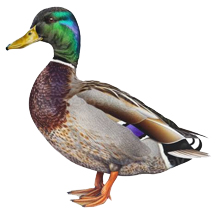
Plumage: The plumage of the Mallard Duck varies drastically depending on the bird's sex and the time of the year due to unique seasonal molting patterns. Male: Highly recognizable by a gleaming, iridescent forest-green head. They have a narrow white collar around the neck, a rich chestnut-brown breast, a silver-gray body, a black rump, and distinct curled black center tail feathers. Their bills are solid bright yellow or olive-green. Female: Entirely cloaked in mottled brown and tan feathers designed for camouflage while nesting on the ground. They feature a dark brown crown, a prominent dark eye-stripe, and an orange bill heavily smudged with black markings. Regardless of sex, age, or season, all Mallard ducks possess a speculum—a vibrant, iridescent violet-blue patch of feathers on the trailing edge of their wings.
Habitat: Mallard ducks thrive in a vast array of wetland habitats, including lakes, ponds, marshes, rivers, and coastal bays. They are highly adaptable and frequently occupy urban environments like city parks and residential backyards. During breeding season, they prefer shallow, temporary wetlands to forage for aquatic invertebrates. Mallards are dabbling ducks, meaning they require shallow water (typically 6 inches to 2 feet deep) where they can tip forward to feed on seeds and aquatic vegetation without diving. In the winter, they flock to grain and agricultural fields (e.g., corn, wheat, and rice) and sheltered bays or swamps.
Egg & Nest Details: Mallard ducks build shallow, ground nests lined with grass, leaves, and soft down feathers. They lay 8 to 13 creamy or greenish-buff eggs, one per day. The mother only sits on the nest full-time once all eggs are laid, incubating them for about 28 days. Mallards usually nest on the ground near water, but they often choose safe spots in yards, under bushes, or in flower pots. The nest looks like a bowl scraped into the ground, hidden by tall grass or plants. The eggs are about two inches long and have a smooth, pale tan or greenish color.
Diet: Mallard ducks are omnivorous, opportunistic feeders. In the wild, they "dabble" in shallow water—tipping upside down to forage on aquatic plants, seeds, and roots, as well as insects, snails, and small amphibians. If you are feeding them, healthy alternatives to avoid empty-calorie bread include frozen peas, oats, lettuce, and cracked corn. A well-rounded mallard diet changes slightly depending on the season and where they are foraging. Plant Matter: Makes up the vast majority of their diet and includes grasses, seeds, wild lilies, cattails, acorns, and agricultural grains. Protein: Particularly important during breeding and nesting seasons, mallards consume insects, worms, tadpoles, freshwater shrimp, and small fish.
Sounds: The quintessential, loud "quack" is exclusively made by the female mallard hen, while the male drake produces a much quieter, raspy, one- or two-note call often transcribed as a low "raehb-raehb". Mallards are incredibly vocal birds, utilizing an array of distinct vocalizations to communicate everything from courtship displays to immediate danger alerts. The Basic Quack: A sharp, clear note given primarily by the female hen. She often delivers this in a rhythmic series of 2 to 10 quacks that start out loud and gradually decrease in volume and pitch.
Brief Description: The Mallard is a medium-sized duck commonly found in ponds and parks. Males have a bright green head, white neck ring, and gray body. Females are brown and tan. Both have a bright blue patch on their wings. They are "dabbling ducks," meaning they tip their tails up to eat from the bottom of the water. Weight: 2 to 3 lbs. (about 1 to 1.4 kg)Length: 20 to 26 inches (50 to 65 cm)Wingspan: 32 to 38 inches (82 to 95 cm).
Plumage: The plumage of the Mallard Duck varies drastically depending on the bird's sex and the time of the year due to unique seasonal molting patterns. Male: Highly recognizable by a gleaming, iridescent forest-green head. They have a narrow white collar around the neck, a rich chestnut-brown breast, a silver-gray body, a black rump, and distinct curled black center tail feathers. Their bills are solid bright yellow or olive-green. Female: Entirely cloaked in mottled brown and tan feathers designed for camouflage while nesting on the ground. They feature a dark brown crown, a prominent dark eye-stripe, and an orange bill heavily smudged with black markings. Regardless of sex, age, or season, all Mallard ducks possess a speculum—a vibrant, iridescent violet-blue patch of feathers on the trailing edge of their wings.
Habitat: Mallard ducks thrive in a vast array of wetland habitats, including lakes, ponds, marshes, rivers, and coastal bays. They are highly adaptable and frequently occupy urban environments like city parks and residential backyards. During breeding season, they prefer shallow, temporary wetlands to forage for aquatic invertebrates. Mallards are dabbling ducks, meaning they require shallow water (typically 6 inches to 2 feet deep) where they can tip forward to feed on seeds and aquatic vegetation without diving. In the winter, they flock to grain and agricultural fields (e.g., corn, wheat, and rice) and sheltered bays or swamps.
Egg & Nest Details: Mallard ducks build shallow, ground nests lined with grass, leaves, and soft down feathers. They lay 8 to 13 creamy or greenish-buff eggs, one per day. The mother only sits on the nest full-time once all eggs are laid, incubating them for about 28 days. Mallards usually nest on the ground near water, but they often choose safe spots in yards, under bushes, or in flower pots. The nest looks like a bowl scraped into the ground, hidden by tall grass or plants. The eggs are about two inches long and have a smooth, pale tan or greenish color.
Diet: Mallard ducks are omnivorous, opportunistic feeders. In the wild, they "dabble" in shallow water—tipping upside down to forage on aquatic plants, seeds, and roots, as well as insects, snails, and small amphibians. If you are feeding them, healthy alternatives to avoid empty-calorie bread include frozen peas, oats, lettuce, and cracked corn. A well-rounded mallard diet changes slightly depending on the season and where they are foraging. Plant Matter: Makes up the vast majority of their diet and includes grasses, seeds, wild lilies, cattails, acorns, and agricultural grains. Protein: Particularly important during breeding and nesting seasons, mallards consume insects, worms, tadpoles, freshwater shrimp, and small fish.
Sounds: The quintessential, loud "quack" is exclusively made by the female mallard hen, while the male drake produces a much quieter, raspy, one- or two-note call often transcribed as a low "raehb-raehb". Mallards are incredibly vocal birds, utilizing an array of distinct vocalizations to communicate everything from courtship displays to immediate danger alerts. The Basic Quack: A sharp, clear note given primarily by the female hen. She often delivers this in a rhythmic series of 2 to 10 quacks that start out loud and gradually decrease in volume and pitch.