House Sparrow
Return to visitors index
Scientific Name:
Passer domesticus
Brief Description: The House Sparrow is a small, stocky bird that loves living near humans. It has a thick beak for eating seeds. Males have a black bib, gray head, and white cheeks. Females and young are plain brown. Introduced to North America from Europe in 1851, they are now highly common. Socializing: Noisy, highly social birds that forage in chatter-filled flocks, hop rather than walk, and frequently engage in communal dust bathing. They can be quite aggressive and will chase native birds away from nesting boxes. Size: Compact body measuring 14 to 18 cm (5.5 to 7.1 in) long with a short tail and stout, conical bill.
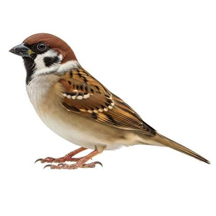
Plumage: House sparrows have two main plumage types depending on sex. Females and juveniles wear buffy-brown and dingy gray-brown feathers. They molt once a year in the fall. Their bright spring look happens when pale feather tips naturally wear away over winter. he male is brightly colored with highly contrasting markings, though seasonal changes alter his appearance. Head: Features a distinct steel-gray crown (cap) bordered by rich chestnut-brown on the sides of the head and nape. The cheeks are vivid white or pale gray. The "Bib": A prominent black throat patch and breast bib. A larger, darker bib signals higher social status and dominance to other rivals. Body and Wings: The back is heavily streaked with black and warm brown. Wings feature a noticeable white wingbar. The chest and belly are plain pearly-gray.
Habitat: House sparrows are inextricably linked to human development, thriving in urban, suburban, and agricultural landscapes. They rely heavily on man-made structures—like eaves, vents, streetlights, and barns—for nesting. They avoid extensive woodlands and deep deserts, preferring environments with readily available food from bird feeders, crop fields, and urban waste. House sparrows have adapted almost entirely to human presence. They actively avoid unbroken, dense forests, alpine regions, and arid, waterless deserts far from human civilization.
Egg & Nest Details: Opportunistic builders, they nest in building crevices, streetlights, soffits, dense vines, and nest boxes. They are known to aggressively usurp the nesting cavities of native cavity-nesting birds like bluebirds. House sparrow eggs are tiny—about the size of a jellybean—and colored white, pale blue-green, or gray, with heavy brown or gray speckles. They are laid in large, messy, dome-shaped nests made of coarse grass, twigs, string, and trash, often built in building crevices, vents, or birdhouses. Egg Size: Approximately 2 to 2.2 cm (0.8 to 0.9 inches) long and 1.4 to 1.6 cm (0.6 inches) wide. Clutch Size: Typically 3 to 5 eggs, but can range from 1 to 8. The female lays one egg per day.
Diet: House sparrows are opportunistic omnivores that primarily eat seeds, grains, and agricultural crops. They frequently supplement their diet with insects, fruit, and discarded human food scraps. Seeds and Grains: These make up the bulk of their diet. In the wild and at backyard feeders, they eagerly consume millet, cracked corn, oats, wheat, sorghum, and sunflower seeds. Insects: While adults eat mostly seeds, insects and their larvae make up the majority of a nestling's diet during the summer. Sparrows actively hunt for caterpillars, beetles, and wasps. Human Food & Trash: Especially in urban areas, sparrows will eat almost anything. They frequent parks and patios scavenging for breadcrumbs, chips, and discarded food scraps. Other Foods: They occasionally eat buds, young plants, berries, and suet.
Sounds: House Sparrows produce simple, monotonous, and non-musical vocalizations consisting primarily of short "cheep" and "chirrup" notes. Unlike true songbirds, they do not have a fluid, melodic song. Instead, they rely on a few distinct chattering and chipping sounds to communicate. A repetitive, monotonous string of shrill "cheep" or "chirrup" notes. Male birds repeat this incessantly throughout the year near their nesting sites to claim territory and attract females.
Brief Description: The House Sparrow is a small, stocky bird that loves living near humans. It has a thick beak for eating seeds. Males have a black bib, gray head, and white cheeks. Females and young are plain brown. Introduced to North America from Europe in 1851, they are now highly common. Socializing: Noisy, highly social birds that forage in chatter-filled flocks, hop rather than walk, and frequently engage in communal dust bathing. They can be quite aggressive and will chase native birds away from nesting boxes. Size: Compact body measuring 14 to 18 cm (5.5 to 7.1 in) long with a short tail and stout, conical bill.
Plumage: House sparrows have two main plumage types depending on sex. Females and juveniles wear buffy-brown and dingy gray-brown feathers. They molt once a year in the fall. Their bright spring look happens when pale feather tips naturally wear away over winter. he male is brightly colored with highly contrasting markings, though seasonal changes alter his appearance. Head: Features a distinct steel-gray crown (cap) bordered by rich chestnut-brown on the sides of the head and nape. The cheeks are vivid white or pale gray. The "Bib": A prominent black throat patch and breast bib. A larger, darker bib signals higher social status and dominance to other rivals. Body and Wings: The back is heavily streaked with black and warm brown. Wings feature a noticeable white wingbar. The chest and belly are plain pearly-gray.
Habitat: House sparrows are inextricably linked to human development, thriving in urban, suburban, and agricultural landscapes. They rely heavily on man-made structures—like eaves, vents, streetlights, and barns—for nesting. They avoid extensive woodlands and deep deserts, preferring environments with readily available food from bird feeders, crop fields, and urban waste. House sparrows have adapted almost entirely to human presence. They actively avoid unbroken, dense forests, alpine regions, and arid, waterless deserts far from human civilization.
Egg & Nest Details: Opportunistic builders, they nest in building crevices, streetlights, soffits, dense vines, and nest boxes. They are known to aggressively usurp the nesting cavities of native cavity-nesting birds like bluebirds. House sparrow eggs are tiny—about the size of a jellybean—and colored white, pale blue-green, or gray, with heavy brown or gray speckles. They are laid in large, messy, dome-shaped nests made of coarse grass, twigs, string, and trash, often built in building crevices, vents, or birdhouses. Egg Size: Approximately 2 to 2.2 cm (0.8 to 0.9 inches) long and 1.4 to 1.6 cm (0.6 inches) wide. Clutch Size: Typically 3 to 5 eggs, but can range from 1 to 8. The female lays one egg per day.
Diet: House sparrows are opportunistic omnivores that primarily eat seeds, grains, and agricultural crops. They frequently supplement their diet with insects, fruit, and discarded human food scraps. Seeds and Grains: These make up the bulk of their diet. In the wild and at backyard feeders, they eagerly consume millet, cracked corn, oats, wheat, sorghum, and sunflower seeds. Insects: While adults eat mostly seeds, insects and their larvae make up the majority of a nestling's diet during the summer. Sparrows actively hunt for caterpillars, beetles, and wasps. Human Food & Trash: Especially in urban areas, sparrows will eat almost anything. They frequent parks and patios scavenging for breadcrumbs, chips, and discarded food scraps. Other Foods: They occasionally eat buds, young plants, berries, and suet.
Sounds: House Sparrows produce simple, monotonous, and non-musical vocalizations consisting primarily of short "cheep" and "chirrup" notes. Unlike true songbirds, they do not have a fluid, melodic song. Instead, they rely on a few distinct chattering and chipping sounds to communicate. A repetitive, monotonous string of shrill "cheep" or "chirrup" notes. Male birds repeat this incessantly throughout the year near their nesting sites to claim territory and attract females.