Gray Catbird
Return to visitors index
Scientific Name:
Dumetella carolinensis
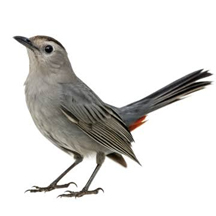
Brief Description: The Gray Catbird is a medium-sized, slate-gray songbird known for its bold black cap, long tail, and rusty feathers under its tail. It gets its name from its signature call, which sounds exactly like a cat's "meow". It loves to hide in thick, leafy bushes. It is a medium-sized migratory songbird native to North America, best known for its distinctive, cat-like "meow" call. It belongs to the family Mimidae, making it a close relative of mockingbirds and thrashers.
Plumage: The Gray Catbird has a mostly slate-gray body, a small black cap on its head, and a long black tail. A bright rusty-brown patch of feathers sits just beneath the base of its tail. Males and females look exactly alike. Juveniles look similar but have a paler cap and buffy feathers. The body feathers change how they look based on the light, ranging from dark gray on the back to a lighter gray on the chest. This coloring acts as camouflage. Camouflage is a natural disguise that lets the bird blend into thick bushes and deep shadows. When they hide in thick brush, the dark gray makes them invisible to predators.
Habitat: The Gray Catbird breeds across southern Canada, the Midwest, and the Eastern United States. For the winter, they migrate to the coastal Southeastern US, Mexico, and Central America. They prefer dense, scrubby habitats like forest edges, thickets, and suburban gardens. The summer breeding range spans from southern British Columbia and the Canadian Maritimes down through the entire eastern half of the United States. They are mostly absent in the arid southwestern US and California. In the winter they spend winters along the Atlantic and Gulf coasts (from Virginia down to Florida and Texas) and throughout Central America and the Caribbean.
Egg & Nest Details: Gray Catbirds build bulky open-cup nests in thick shrubs or vines. Females lay 1 to 6 turquoise-green eggs that measure about 2.5 cm in length. Incubation takes 12 to 15 days. Catbirds cleverly recognize and toss out foreign eggs laid by other birds. Females build the nest. They hide it in dense tangles of vines, briers, or shrubs, usually 3 to 10 feet above the ground. The outside is made of twigs, bark, and mud. The inside is lined with fine rootlets, hair, and soft grass.
Diet: Gray Catbirds are omnivores. Their diet is split between insects in the spring and summer, and fruits in the fall and winter. During breeding season, they feed on ants, beetles, and caterpillars. Year-round, they heavily consume berries, such as cherries, blackberries, and elderberries. To attract them to your yard, you can offer grape jelly, oranges, raisins, and dried mealworms in flat tray feeders. Because they rely on forest edges, thickets, and suburban undergrowth, Gray Catbirds are common visitors to backyard gardens.
Sounds: The Gray Catbird is most famous for its distinctive, raspy "mew" call that sounds exactly like a crying kitten. Beyond this signature sound, it is a highly skilled mimic capable of producing an erratic, minutes-long song composed of whistles, squeaks, and gurgles stolen from other birds, frogs, and mechanical objects.
Brief Description: The Gray Catbird is a medium-sized, slate-gray songbird known for its bold black cap, long tail, and rusty feathers under its tail. It gets its name from its signature call, which sounds exactly like a cat's "meow". It loves to hide in thick, leafy bushes. It is a medium-sized migratory songbird native to North America, best known for its distinctive, cat-like "meow" call. It belongs to the family Mimidae, making it a close relative of mockingbirds and thrashers.
Plumage: The Gray Catbird has a mostly slate-gray body, a small black cap on its head, and a long black tail. A bright rusty-brown patch of feathers sits just beneath the base of its tail. Males and females look exactly alike. Juveniles look similar but have a paler cap and buffy feathers. The body feathers change how they look based on the light, ranging from dark gray on the back to a lighter gray on the chest. This coloring acts as camouflage. Camouflage is a natural disguise that lets the bird blend into thick bushes and deep shadows. When they hide in thick brush, the dark gray makes them invisible to predators.
Habitat: The Gray Catbird breeds across southern Canada, the Midwest, and the Eastern United States. For the winter, they migrate to the coastal Southeastern US, Mexico, and Central America. They prefer dense, scrubby habitats like forest edges, thickets, and suburban gardens. The summer breeding range spans from southern British Columbia and the Canadian Maritimes down through the entire eastern half of the United States. They are mostly absent in the arid southwestern US and California. In the winter they spend winters along the Atlantic and Gulf coasts (from Virginia down to Florida and Texas) and throughout Central America and the Caribbean.
Egg & Nest Details: Gray Catbirds build bulky open-cup nests in thick shrubs or vines. Females lay 1 to 6 turquoise-green eggs that measure about 2.5 cm in length. Incubation takes 12 to 15 days. Catbirds cleverly recognize and toss out foreign eggs laid by other birds. Females build the nest. They hide it in dense tangles of vines, briers, or shrubs, usually 3 to 10 feet above the ground. The outside is made of twigs, bark, and mud. The inside is lined with fine rootlets, hair, and soft grass.
Diet: Gray Catbirds are omnivores. Their diet is split between insects in the spring and summer, and fruits in the fall and winter. During breeding season, they feed on ants, beetles, and caterpillars. Year-round, they heavily consume berries, such as cherries, blackberries, and elderberries. To attract them to your yard, you can offer grape jelly, oranges, raisins, and dried mealworms in flat tray feeders. Because they rely on forest edges, thickets, and suburban undergrowth, Gray Catbirds are common visitors to backyard gardens.
Sounds: The Gray Catbird is most famous for its distinctive, raspy "mew" call that sounds exactly like a crying kitten. Beyond this signature sound, it is a highly skilled mimic capable of producing an erratic, minutes-long song composed of whistles, squeaks, and gurgles stolen from other birds, frogs, and mechanical objects.