European Starling
Return to visitors index
Scientific Name:
Sturnus vulgaris
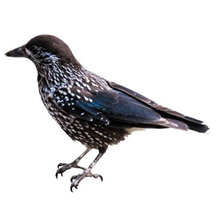
Brief Description: European Starlings are stocky black songbirds, roughly 8 inches long with a 16-inch wingspan. They feature short, triangular wings, a short square tail, and a dagger-like bill. During the summer, adults turn glossy, iridescent green and purple with a bright yellow beak. In winter, their plumage fades to a dark brown covered in bold white spots, and their bill turns black. Chunky, robin-sized birds that walk rather than hop on the ground. In flight, their wings look sharply pointed and star-shaped. Starlings are highly gregarious and aggressive, famous for gathering in massive, noisy flocks that can number in the tens of thousands.
Plumage: European Starlings change colors with the seasons. In summer, adults are shiny black with a bright yellow bill. In winter, their dark feathers grow white tips, creating a starry, spotted pattern, and the bill turns dark. Young starlings are completely dusty gray-brown. Glossy black feathers that shine with green and purple in the sunlight and a bill solid, bright yellow. Males have a blue base, and females have a pink base and pinkish-red legs.
Habitat: European Starlings thrive in environments heavily altered by human activity. They require open grassy areas for foraging, such as lawns, pastures, and city parks, alongside cavities in trees or man-made structures for nesting. They generally avoid dense forests and high mountain ranges. Starlings are terrestrial foragers that rely heavily on short grasslands, mowed lawns, and agricultural fields to stab the ground for insects, seeds, and fallen fruit. Outside of the breeding season, starlings gather in massive, highly vocal flocks. They roost overnight in dense vegetation like reedbeds, conifer plantations, or urban city centers (such as bridges and large buildings).
Egg & Nest Details: European Starlings build messy, bulky nests out of twigs, dry grass, and trash. They prefer to build them in hidden spaces like tree holes, birdhouses, and vents in your house. Females lay 4 to 6 pale blue or greenish-white eggs. Both parents take turns keeping the eggs warm. Starlings nest from March through July and often have two broods a year. Nests are usually 10 to 25 feet high but can be as high as 60 feet. The eggs are about 1.1 inches long and 0.8 inches wide. They are slightly smaller than a robin's egg. A starling egg is usually unmarked, but some have tiny red-brown spots.
Diet: European starlings are highly adaptable omnivores. Their diet shifts seasonally: in the spring and summer, they eat protein-rich insects and earthworms, while in the fall and winter, they rely heavily on fruits, berries, seeds, and grains. They will also readily eat pet food, livestock feed, and kitchen scraps. Starlings are infamous for raiding feeders. They are highly attracted to suet, mealworms, and black-oil sunflower seeds. Because of their adaptability, these birds can become aggressive competitors at local foraging spots.
Sounds: The European Starling produces a chaotic, mechanical, and highly varied medley of whistles, clicks, rattles, chaps, and pops, while acting as one of nature's most brilliant mimics. Because they can produce two independent tones at the same time using their specialized vocal organ (the syrinx), their vocalizations often carry an eerie, dual-tone electronic quality.
Brief Description: European Starlings are stocky black songbirds, roughly 8 inches long with a 16-inch wingspan. They feature short, triangular wings, a short square tail, and a dagger-like bill. During the summer, adults turn glossy, iridescent green and purple with a bright yellow beak. In winter, their plumage fades to a dark brown covered in bold white spots, and their bill turns black. Chunky, robin-sized birds that walk rather than hop on the ground. In flight, their wings look sharply pointed and star-shaped. Starlings are highly gregarious and aggressive, famous for gathering in massive, noisy flocks that can number in the tens of thousands.
Plumage: European Starlings change colors with the seasons. In summer, adults are shiny black with a bright yellow bill. In winter, their dark feathers grow white tips, creating a starry, spotted pattern, and the bill turns dark. Young starlings are completely dusty gray-brown. Glossy black feathers that shine with green and purple in the sunlight and a bill solid, bright yellow. Males have a blue base, and females have a pink base and pinkish-red legs.
Habitat: European Starlings thrive in environments heavily altered by human activity. They require open grassy areas for foraging, such as lawns, pastures, and city parks, alongside cavities in trees or man-made structures for nesting. They generally avoid dense forests and high mountain ranges. Starlings are terrestrial foragers that rely heavily on short grasslands, mowed lawns, and agricultural fields to stab the ground for insects, seeds, and fallen fruit. Outside of the breeding season, starlings gather in massive, highly vocal flocks. They roost overnight in dense vegetation like reedbeds, conifer plantations, or urban city centers (such as bridges and large buildings).
Egg & Nest Details: European Starlings build messy, bulky nests out of twigs, dry grass, and trash. They prefer to build them in hidden spaces like tree holes, birdhouses, and vents in your house. Females lay 4 to 6 pale blue or greenish-white eggs. Both parents take turns keeping the eggs warm. Starlings nest from March through July and often have two broods a year. Nests are usually 10 to 25 feet high but can be as high as 60 feet. The eggs are about 1.1 inches long and 0.8 inches wide. They are slightly smaller than a robin's egg. A starling egg is usually unmarked, but some have tiny red-brown spots.
Diet: European starlings are highly adaptable omnivores. Their diet shifts seasonally: in the spring and summer, they eat protein-rich insects and earthworms, while in the fall and winter, they rely heavily on fruits, berries, seeds, and grains. They will also readily eat pet food, livestock feed, and kitchen scraps. Starlings are infamous for raiding feeders. They are highly attracted to suet, mealworms, and black-oil sunflower seeds. Because of their adaptability, these birds can become aggressive competitors at local foraging spots.
Sounds: The European Starling produces a chaotic, mechanical, and highly varied medley of whistles, clicks, rattles, chaps, and pops, while acting as one of nature's most brilliant mimics. Because they can produce two independent tones at the same time using their specialized vocal organ (the syrinx), their vocalizations often carry an eerie, dual-tone electronic quality.