Downy Woodpecker
Return to visitors index
Scientific Name:
Dryobates pubescents
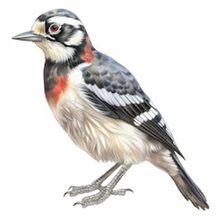
Brief Description: The Downy Woodpecker is North America's smallest woodpecker. It is a tiny black-and-white bird, about the size of a sparrow. It is famous for its stubby beak and broad white stripe down its back. You can easily spot them in trees and at backyard bird feeders. Here are a few more details to help you identify them: They measure just 5 to 7 inches long. Their beak is very short—about half the width of their head. They look almost identical to the larger Hairy Woodpecker. A great way to tell them apart is by looking at the outer tail feathers; Downies have small black spots on these white feathers, while Hairy Woodpeckers do not.
Plumage: Downy Woodpecker feathers are primarily checkered black and white, featuring a soft, white stripe down the back. The name "Downy" originates from these extremely soft, downy-like back feathers, as well as the specialized bristly nasal tufts covering their nostrils to filter out wood chips while pecking. Like all woodpeckers, their central tail feathers are stiff, pointed, and strongly reinforced to act as a prop or "kickstand" while they grip and hammer into trees.
Habitat: Downy Woodpeckers thrive in open deciduous woodlands, parks, orchards, and suburban backyards across North America. Because they are highly adaptable, they use a wide variety of trees and require dead wood for foraging and excavating roosting or nesting cavities. Their primary are open deciduous forests, woodlots, river groves, and willows.Human-Modified Spaces: Readily found in city parks, orchards, and residential backyards. They span from coast to coast across the United States and Canada, with western populations generally being darker with less white on their wings.
Egg & Nest Details: Downy Woodpecker nests are cavities dug into dead trees. Both male and female birds build the nest by pecking a round, 1.5-inch hole. The cavity goes down 6 to 11 inches. The bottom is lined with soft wood chips. The female lays 3 to 8 plain white eggs. Both parents take turns sitting on the eggs for 12 days. The eggs are very small, measuring only about 0.8 inches long and 0.6 inches wide. When they hatch, the babies are naked, pink, and completely helpless. Both mom and dad work hard to feed them insects. The babies will fly out of the nest in 18 to 21 days.
Diet: Downy woodpeckers are omnivores that primarily eat insects, such as beetles, ants, and caterpillars, which make up about 75% of their diet. The remaining portion consists of plant materials like berries, acorns, and seeds. At backyard feeders, they love suet, black oil sunflower seeds, and peanuts. They extract wood-boring beetle larvae, spiders, and even mud dauber wasp nests from crevices using their long, barbed tongues. They are also known to hunt for insect galls hidden inside the stems of tall weeds like goldenrod. You can easily attract them to your yard with suet feeders or by offering peanuts, black oil sunflower seeds, and chunky peanut butter.
Sounds: The Downy Woodpecker has three distinct primary sounds used for communication: a sharp "pik" note, a descending whinny, and a rhythmic drumming pattern. Because they are North America's smallest woodpeckers, their vocalizations are higher-pitched and less booming than those of their larger relatives.
Brief Description: The Downy Woodpecker is North America's smallest woodpecker. It is a tiny black-and-white bird, about the size of a sparrow. It is famous for its stubby beak and broad white stripe down its back. You can easily spot them in trees and at backyard bird feeders. Here are a few more details to help you identify them: They measure just 5 to 7 inches long. Their beak is very short—about half the width of their head. They look almost identical to the larger Hairy Woodpecker. A great way to tell them apart is by looking at the outer tail feathers; Downies have small black spots on these white feathers, while Hairy Woodpeckers do not.
Plumage: Downy Woodpecker feathers are primarily checkered black and white, featuring a soft, white stripe down the back. The name "Downy" originates from these extremely soft, downy-like back feathers, as well as the specialized bristly nasal tufts covering their nostrils to filter out wood chips while pecking. Like all woodpeckers, their central tail feathers are stiff, pointed, and strongly reinforced to act as a prop or "kickstand" while they grip and hammer into trees.
Habitat: Downy Woodpeckers thrive in open deciduous woodlands, parks, orchards, and suburban backyards across North America. Because they are highly adaptable, they use a wide variety of trees and require dead wood for foraging and excavating roosting or nesting cavities. Their primary are open deciduous forests, woodlots, river groves, and willows.Human-Modified Spaces: Readily found in city parks, orchards, and residential backyards. They span from coast to coast across the United States and Canada, with western populations generally being darker with less white on their wings.
Egg & Nest Details: Downy Woodpecker nests are cavities dug into dead trees. Both male and female birds build the nest by pecking a round, 1.5-inch hole. The cavity goes down 6 to 11 inches. The bottom is lined with soft wood chips. The female lays 3 to 8 plain white eggs. Both parents take turns sitting on the eggs for 12 days. The eggs are very small, measuring only about 0.8 inches long and 0.6 inches wide. When they hatch, the babies are naked, pink, and completely helpless. Both mom and dad work hard to feed them insects. The babies will fly out of the nest in 18 to 21 days.
Diet: Downy woodpeckers are omnivores that primarily eat insects, such as beetles, ants, and caterpillars, which make up about 75% of their diet. The remaining portion consists of plant materials like berries, acorns, and seeds. At backyard feeders, they love suet, black oil sunflower seeds, and peanuts. They extract wood-boring beetle larvae, spiders, and even mud dauber wasp nests from crevices using their long, barbed tongues. They are also known to hunt for insect galls hidden inside the stems of tall weeds like goldenrod. You can easily attract them to your yard with suet feeders or by offering peanuts, black oil sunflower seeds, and chunky peanut butter.
Sounds: The Downy Woodpecker has three distinct primary sounds used for communication: a sharp "pik" note, a descending whinny, and a rhythmic drumming pattern. Because they are North America's smallest woodpeckers, their vocalizations are higher-pitched and less booming than those of their larger relatives.