American Goldfinch
Return to visitors index
Scientific Name:
Spinus tristis
Brief Description: The American Goldfinch is a small, sparrow-sized songbird (4–5 in.) with a short conical bill and bouncy, undulating flight. It is celebrated for its seasonal plumage shifts, twice-yearly molts, and status as the state bird of New Jersey, Iowa, and Washington.
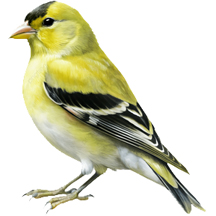
Plumage: Summer Males: Bright, sunshine-yellow bodies with contrasting jet-black wings, tail, and a black forehead patch, paired with a bright orange bill. Summer Females: Duller olive-yellow, with blackish wings and white wing bars. Winter Birds: Both sexes look similar to summer females but fade to a drab, buffy grayish-brown with dark beaks, though they retain their distinct wing bars.
Habitat: American Goldfinches thrive in semi-open environments with trees, shrubs, and abundant seed-producing plants like thistles, sunflowers, and dandelions. They are commonly found in weedy fields, meadows, floodplains, roadsides, and suburban gardens across North America, avoiding deep forests.
Egg & Nest Details: Appearance: Pale bluish-white, sometimes with faint brown spots near the larger end. Size: Small ovals, roughly 0.6–0.7 inches long and 0.5 inches wide. Nest Location: Females build tiny, tight, watertight cups from plant fibers and spiderwebs, typically placing them in trees or dense shrubs 4 to 10 feet off the ground.
Diet: These strict vegetarians feed almost exclusively on seeds—especially from thistles, dandelions, and sunflowers. They have a distinct and complex melodic song, and their bouncy, "rollercoaster-like" flight is often punctuated by a famous "potato-chip" contact call. They are highly gregarious and can frequently be found in weedy fields, overgrown roadsides, and backyard bird feeders. Unlike most songbirds, they nest very late in the summer (July to September) to align with peak thistle seed production.
Sounds: The American Goldfinch communicates through a distinctive series of bouncy, musical twitters and a highly recognizable flight call that sounds like it is saying "potato chip".
Brief Description: The American Goldfinch is a small, sparrow-sized songbird (4–5 in.) with a short conical bill and bouncy, undulating flight. It is celebrated for its seasonal plumage shifts, twice-yearly molts, and status as the state bird of New Jersey, Iowa, and Washington.
Plumage: Summer Males: Bright, sunshine-yellow bodies with contrasting jet-black wings, tail, and a black forehead patch, paired with a bright orange bill. Summer Females: Duller olive-yellow, with blackish wings and white wing bars. Winter Birds: Both sexes look similar to summer females but fade to a drab, buffy grayish-brown with dark beaks, though they retain their distinct wing bars.
Habitat: American Goldfinches thrive in semi-open environments with trees, shrubs, and abundant seed-producing plants like thistles, sunflowers, and dandelions. They are commonly found in weedy fields, meadows, floodplains, roadsides, and suburban gardens across North America, avoiding deep forests.
Egg & Nest Details: Appearance: Pale bluish-white, sometimes with faint brown spots near the larger end. Size: Small ovals, roughly 0.6–0.7 inches long and 0.5 inches wide. Nest Location: Females build tiny, tight, watertight cups from plant fibers and spiderwebs, typically placing them in trees or dense shrubs 4 to 10 feet off the ground.
Diet: These strict vegetarians feed almost exclusively on seeds—especially from thistles, dandelions, and sunflowers. They have a distinct and complex melodic song, and their bouncy, "rollercoaster-like" flight is often punctuated by a famous "potato-chip" contact call. They are highly gregarious and can frequently be found in weedy fields, overgrown roadsides, and backyard bird feeders. Unlike most songbirds, they nest very late in the summer (July to September) to align with peak thistle seed production.
Sounds: The American Goldfinch communicates through a distinctive series of bouncy, musical twitters and a highly recognizable flight call that sounds like it is saying "potato chip".