American Crow
Return to visitors index
Scientific Name:
Corvus brachyrhynchos
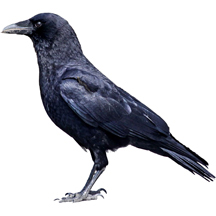
Brief Description: The American Crow is a large, highly intelligent songbird native to North America. It is entirely glossy black with strong legs and a stout bill. Known for its loud, harsh "caw," the crow is highly social, frequently gathering in large, communal roosts and roaming diverse habitats, including farmlands, woodlands, and urban areas. They measure 16 to 21 inches in length with a 33- to 40-inch wingspan.
Plumage: American Crows possess entirely black plumage, from their stout beaks to their long legs. Under direct sunlight, their feathers exhibit a glossy, iridescent sheen that reflects deep blues and purples. Juveniles feature duller, brownish-black feathers that completely lack this gloss until their first molt. Adult crows sport sleek, uniform black contour feathers that merge smoothly down into their breasts, setting them apart from the shaggier, rugged neck hackles of the larger Common Raven.
Habitat: American crows are highly adaptable and thrive in a wide variety of semi-open and human-modified landscapes. They inhabit open woodlands, agricultural fields, parks, cemeteries, and urban centers across North America, while typically avoiding dense, unbroken forests and harsh deserts. Crows do best in transitional environments. They prefer open spaces (such as meadows or grasslands) for foraging, combined with adjacent trees or woodlots to provide perches, roosting spots, and nesting sites.
Egg & Nest Details: American crow nests are bulky, 1.5-foot-wide bowls built high up in the crotches of evergreens or deciduous trees. Females lay clutches of 3 to 9 pale bluish-green eggs heavily blotched with brown and gray. Both parents build the nest, and the female incubates for about 18 days. Nest Construction takes 1-2 weeks. The outer layer is built with pencil-width twigs, while the inner cup is heavily padded with soft materials like tree bark, moss, grass, animal fur, and paper. Typically located 10 to 70 feet above the ground, tightly wedged into a tree's main fork or near the trunk on a horizontal branch.
Diet: American crows are highly opportunistic omnivores. Their diet is roughly 70% plant matter—such as grains, corn, acorns, and berries—and 30% animal matter, including insects, mice, frogs, fish, and eggs. They are also notorious for eating carrion, garbage, and human food scraps. Their diet breaks down into these specific categories: Insects & Small Animals: Beetles, grasshoppers, earthworms, spiders, rodents, small snakes, and lizards. Fruits, Nuts & Seeds: Apples, grapes, cherries, and various tree nuts like pecans and walnuts. Human Food & Leftaways: Unsalted peanuts, eggs (both scrambled and in the shell), dog or cat kibble, and unseasoned table scraps. Other Birds: They frequently raid nests to eat the eggs and nestlings of smaller birds.
Sounds: The American Crow has a surprisingly complex vocabulary of over 20 distinct vocalizations used to communicate everything from territory boundaries to predator warnings. While they are most famous for their classic, harsh "caw-caw" sound, they also use a variety of clicks, rattles, and clear coos. A loud, sharp, repeated "caw, caw, caw". Crows typically thrust their heads up and down as they make this sound to advertise their presence and defend territory.
Brief Description: The American Crow is a large, highly intelligent songbird native to North America. It is entirely glossy black with strong legs and a stout bill. Known for its loud, harsh "caw," the crow is highly social, frequently gathering in large, communal roosts and roaming diverse habitats, including farmlands, woodlands, and urban areas. They measure 16 to 21 inches in length with a 33- to 40-inch wingspan.
Plumage: American Crows possess entirely black plumage, from their stout beaks to their long legs. Under direct sunlight, their feathers exhibit a glossy, iridescent sheen that reflects deep blues and purples. Juveniles feature duller, brownish-black feathers that completely lack this gloss until their first molt. Adult crows sport sleek, uniform black contour feathers that merge smoothly down into their breasts, setting them apart from the shaggier, rugged neck hackles of the larger Common Raven.
Habitat: American crows are highly adaptable and thrive in a wide variety of semi-open and human-modified landscapes. They inhabit open woodlands, agricultural fields, parks, cemeteries, and urban centers across North America, while typically avoiding dense, unbroken forests and harsh deserts. Crows do best in transitional environments. They prefer open spaces (such as meadows or grasslands) for foraging, combined with adjacent trees or woodlots to provide perches, roosting spots, and nesting sites.
Egg & Nest Details: American crow nests are bulky, 1.5-foot-wide bowls built high up in the crotches of evergreens or deciduous trees. Females lay clutches of 3 to 9 pale bluish-green eggs heavily blotched with brown and gray. Both parents build the nest, and the female incubates for about 18 days. Nest Construction takes 1-2 weeks. The outer layer is built with pencil-width twigs, while the inner cup is heavily padded with soft materials like tree bark, moss, grass, animal fur, and paper. Typically located 10 to 70 feet above the ground, tightly wedged into a tree's main fork or near the trunk on a horizontal branch.
Diet: American crows are highly opportunistic omnivores. Their diet is roughly 70% plant matter—such as grains, corn, acorns, and berries—and 30% animal matter, including insects, mice, frogs, fish, and eggs. They are also notorious for eating carrion, garbage, and human food scraps. Their diet breaks down into these specific categories: Insects & Small Animals: Beetles, grasshoppers, earthworms, spiders, rodents, small snakes, and lizards. Fruits, Nuts & Seeds: Apples, grapes, cherries, and various tree nuts like pecans and walnuts. Human Food & Leftaways: Unsalted peanuts, eggs (both scrambled and in the shell), dog or cat kibble, and unseasoned table scraps. Other Birds: They frequently raid nests to eat the eggs and nestlings of smaller birds.
Sounds: The American Crow has a surprisingly complex vocabulary of over 20 distinct vocalizations used to communicate everything from territory boundaries to predator warnings. While they are most famous for their classic, harsh "caw-caw" sound, they also use a variety of clicks, rattles, and clear coos. A loud, sharp, repeated "caw, caw, caw". Crows typically thrust their heads up and down as they make this sound to advertise their presence and defend territory.